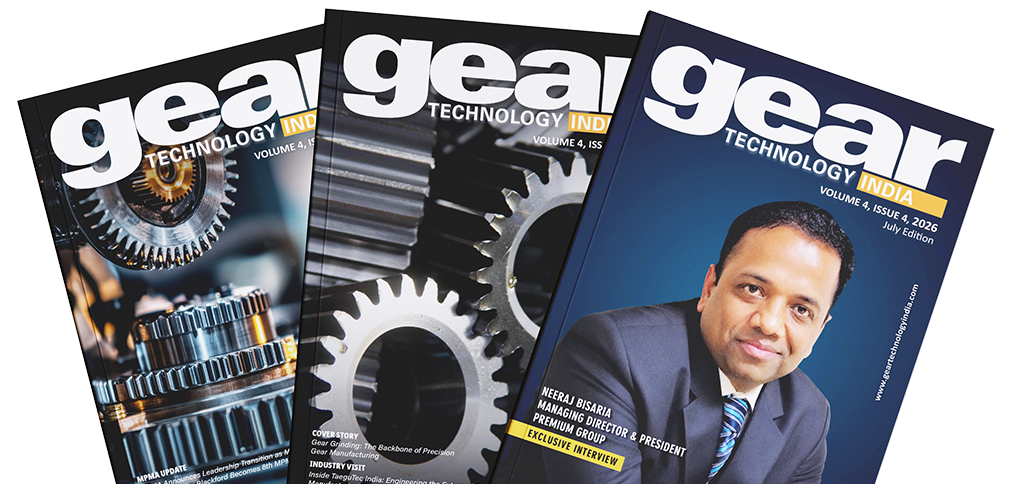
Recently, I had the opportunity to address the GearTech Summit 2026 and interact with stakeholders from the gear fraternity under the banner of IPTEXGRINDEX 2026. What particularly encouraged me was the growing interest of the gear and power transmission industry in the aerospace and defence sector. This signals that India’s journey towards self-reliance is entering a new phase, with second- and third-tier suppliers increasingly exploring opportunities in high-precision defence manufacturing.
The evolution of the aerospace and defence industry has historically been closely tied to industrial progress. The World Wars and the subsequent Cold War accelerated advancements in materials engineering, propulsion systems, precision machining and manufacturing technologies. These developments gave rise to sophisticated military-industrial ecosystems, particularly in the United States and the former Soviet Union, whose technologies continue to influence global defence systems even today.
India’s journey has been different. Since Independence, the country has had to balance economic development with complex geopolitical and security challenges. The vision of military self-reliance was recognised early through the establishment of institutions such as HAL and DRDO. However, immediate operational requirements and security imperatives often necessitated the import of military hardware.
Rather than criticising the pace of self-reliance, it is important to acknowledge the incremental efforts made over the decades, including the licensed production of several defence platforms in Indian factories. These initiatives helped create manufacturing capabilities, develop supplier ecosystems and build a foundation upon which today’s Atmanirbhar Bharat mission is progressing.
India’s remarkable achievements in space exploration stand in contrast to the continuing challenges of achieving complete self-reliance in critical technologies such as aero-engine development. In the space sector, limited access to foreign technologies compelled Indian scientists and engineers to innovate and build indigenous capabilities.
The defence and aerospace ecosystem, however, has followed a different trajectory, influenced by technology-denial regimes, bureaucratic processes, long development cycles and the strategic use of defence procurement as a diplomatic instrument. Nevertheless, there have been notable successes. The BRAHMOS missile programme, developed jointly with Russia, stands as a compelling example of how collaborative development and indigenous manufacturing can create globally respected capabilities.
Encouragingly, initiatives under Atmanirbhar Bharat are beginning to yield tangible results, with India’s defence exports witnessing significant growth and domestic industries increasingly participating in advanced manufacturing programmes.
For the gear and power transmission sector, aerospace and defence present a significant opportunity. Modern military platforms require highly specialised gears and transmission systems that operate under extreme conditions and demand exceptional precision and reliability.
Applications include:
The aerospace sector requires complex alloys with tested structural integrity.
Unlike conventional industrial gears, aerospace gears are required to operate at high rotational speeds, elevated temperatures and varying load conditions. Consequently, they demand advanced manufacturing capabilities, including:
These requirements closely align with the capabilities that India’s leading gear manufacturers are already developing for automotive and industrial applications.
The Cold War era offers important lessons. Russian equipment has traditionally been recognised for its robustness and simplicity, while NATO systems are known for their sophistication and operator-friendly interfaces. India’s unique advantage lies in having operated equipment from both ecosystems.
This experience provides Indian engineers, military veterans and manufacturers with valuable insights into performance expectations, maintainability and operational requirements. Such knowledge can be leveraged to develop products that combine reliability, affordability and advanced engineering.
India’s space programme has demonstrated that world-class engineering can be achieved through cost-effective innovation. The same philosophy can be applied to defence manufacturing.
Rather than attempting to reinvent every technology from the ground up, Indian industry can focus on developing competitive manufacturing processes, precision engineering capabilities and efficient supply chains that enable the production of globally competitive aerospace components.
The nature of warfare is evolving rapidly. Recent conflicts have demonstrated how low-cost drones, autonomous systems and precision-guided technologies can significantly alter the battlefield.
For Indian manufacturers, this shift presents new opportunities. Components for UAVs, electric actuators, precision transmissions, miniature gear systems and advanced mobility platforms are likely to witness increasing demand. Companies that invest in precision manufacturing, automation, digital inspection and advanced materials today will be well-positioned to participate in future defence programmes.
The Indian gear and grinding industry has already demonstrated its capabilities in serving demanding sectors such as automotive, energy and industrial machinery. The next frontier lies in aerospace and defence.
The ecosystem brought together by Gear Technology India has the experience, manufacturing expertise and technological foundation to contribute meaningfully to India’s vision of Atmanirbhar Bharat.
The time has come for the industry to shift into a higher gear and play a pivotal role in building a globally competitive aerospace and defence manufacturing ecosystem.