Authored by: Dinesh Kumar Acharya, Head – Kennametal Knowledge Center, Kennametal India Limited
Abstract
In the competitive landscape of gear manufacturing, the transition from traditional grinding to Hard Part Turning (HPT) offers significant cycle time reductions. This article explores how coupling Cubic Boron Nitride (CBN) with Wiper geometry can exponentially increase feed rates while maintaining surface finishes rivalling grinding operations.
Introduction: The Evolution of Gear Finishing
We can all agree that gear manufacturing is an exacting discipline. It is an engineered product involving critical manufacturing processes where quality demands are unforgiving at every stage. If you are in gear manufacturing, you know the challenges well. In this competitive era, it is essential to be productive, reduce cycle times, and improve quality simultaneously.
Traditionally, the finishing of hardened gears (48–60 HRC) has been the domain of grinding. While grinding is a proven solution used since the 19th century for achieving high quality, it often acts as a bottleneck due to low Material Removal Rates (MRR). This is where smart manufacturing techniques come into the picture: introducing Hard Part Turning (HPT) with Wiper CBN inserts.
The Need for Higher Productivity
High productivity and superior product quality are the need of the hour. Improving productivity means increasing the production rate within the same setup, which is where manufacturing costs are drastically reduced.
Likewise, the advantages of improved quality are self-evident—better product quality naturally leads to fewer rejections and longer tool life. The objective is to elevate the process from simple “machining” to delivering true “engineered solutions.”
Hard Part Machining in Gear Manufacturing
Gear production involves multiple stages, but one of the most critical and time-consuming operations is hard part machining. After heat treatment, gear hardness often exceeds 48 HRC. At this stage, machining is typically done by grinding or Hard Part Turning (HPT) using Ceramics or CBN.
While many industry experts use hard part turning to eliminate grinding, many smart engineers employ HPT as an intermediate operation. By removing the bulk of the material with CBN, they reduce the grinding allowance to as little as 50 microns. This drastically reduces the grinding cycle time—a classic “win-win” situation where the high MRR of turning supports the precision of grinding.
The Role of CBN: A Game Changer
Most gears are machined after heat treatment, whether through-hardened or case-hardened. The resulting surface hardness (48–60 HRC) degrades machinability by 15–30%. Standard Carbide and HSS tools cannot withstand the cutting zone temperatures (>800°C), and Ceramics, while useful, often suffer from thermal shock in interrupted cuts.
This is where Cubic Boron Nitride (CBN) excels. With a hardness of approx. 4000 HV (second only to diamond) and hot hardness stability up to 1400°C, CBN provides the thermal resilience required for hard turning.
Selecting the Right Grade Composition
Success in hard turning depends heavily on matching the grade composition and coating to the application.
Decoding Wiper Technology
To truly boost productivity, we must look at the geometry. A “Wiper” is a specially designed insert edge geometry that decouples surface finish from feed rate.
In standard inserts, higher feeds leave larger “scallop” marks. Wiper geometry features a multi-radius section that “wipes” the surface smooth. Leading tool manufacturers have refined this into specific application-based geometries:

The Productivity Equation
The results are quantifiable. At Kennametal, we have conducted several test cases where the finish achieved by a standard insert at feed “X” mm/rev was achieved by Wiper geometry at 2X to 4X that feed. In short: Wiper CBN inserts = High Productivity + Superior Surface Finish.
Economic Efficiency: Multipoint CBN
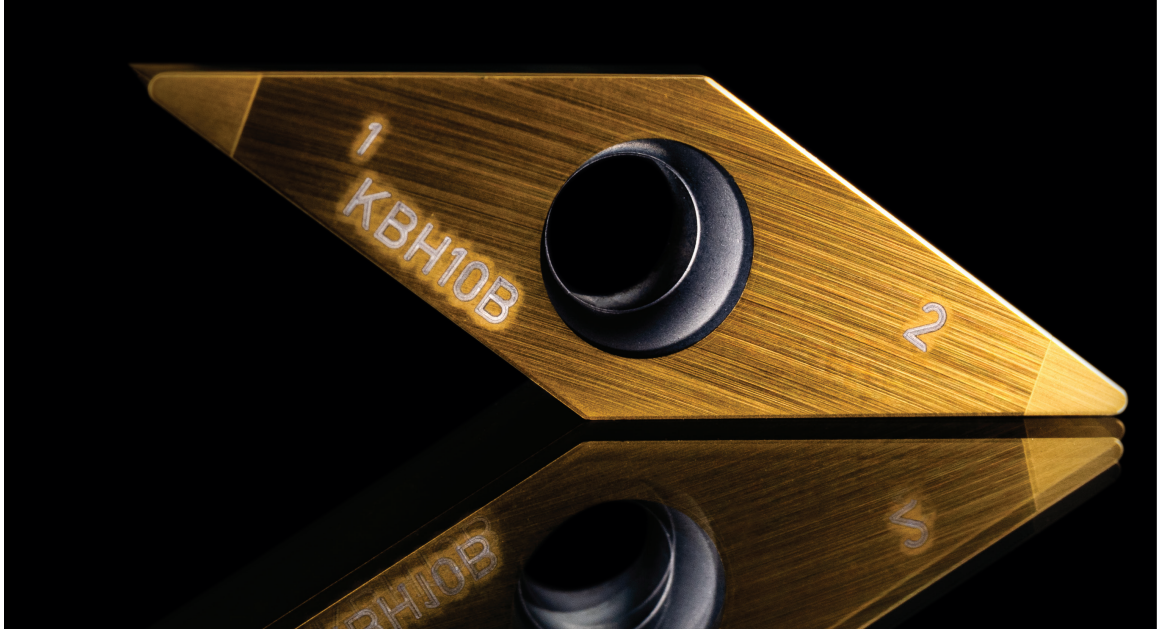
Historically, CBN was seen as a high-cost consumable. However, the industry is shifting towards Multipoint CBN inserts. Unlike traditional “tipped” inserts with only one cutting corner, Multipoint inserts feature multiple brazed tips (often 2, 3, or even 4 corners per insert).
This innovation drastically reduces the cost per cutting edge. When combined with the high feed rates of modern wiper geometries and the durability of advanced coated grades, the total cost per component drops significantly compared to grinding.
The Criticality of Edge Preparation
Product quality is paramount. While Wiper geometry looks simple conceptually, its manufacturing is highly complex. Imagine expecting a component tolerance below 30 microns and a finish below 0.4 Ra—this is impossible without a pristine cutting edge.
This is where Laser Ablation technology comes into play. Although more costly than other edge prep methods, laser cutting provides a highly accurate and precise cutting edge. This precision is what allows the Wiper CBN to deliver consistent, high-quality results on the shop floor.
Conclusion: The Untapped Potential
Surprisingly, available public data shows that today, nearly 80% of gears (with surface hardness >48 HRC) are still finished using only grinding, while only 20% utilize Hard Part Turning.
By integrating advanced solutions—like tough grades for interrupted cuts, optimised Wiper geometries for speed, and Multipoint inserts for economy—manufacturers can gain a massive competitive edge.
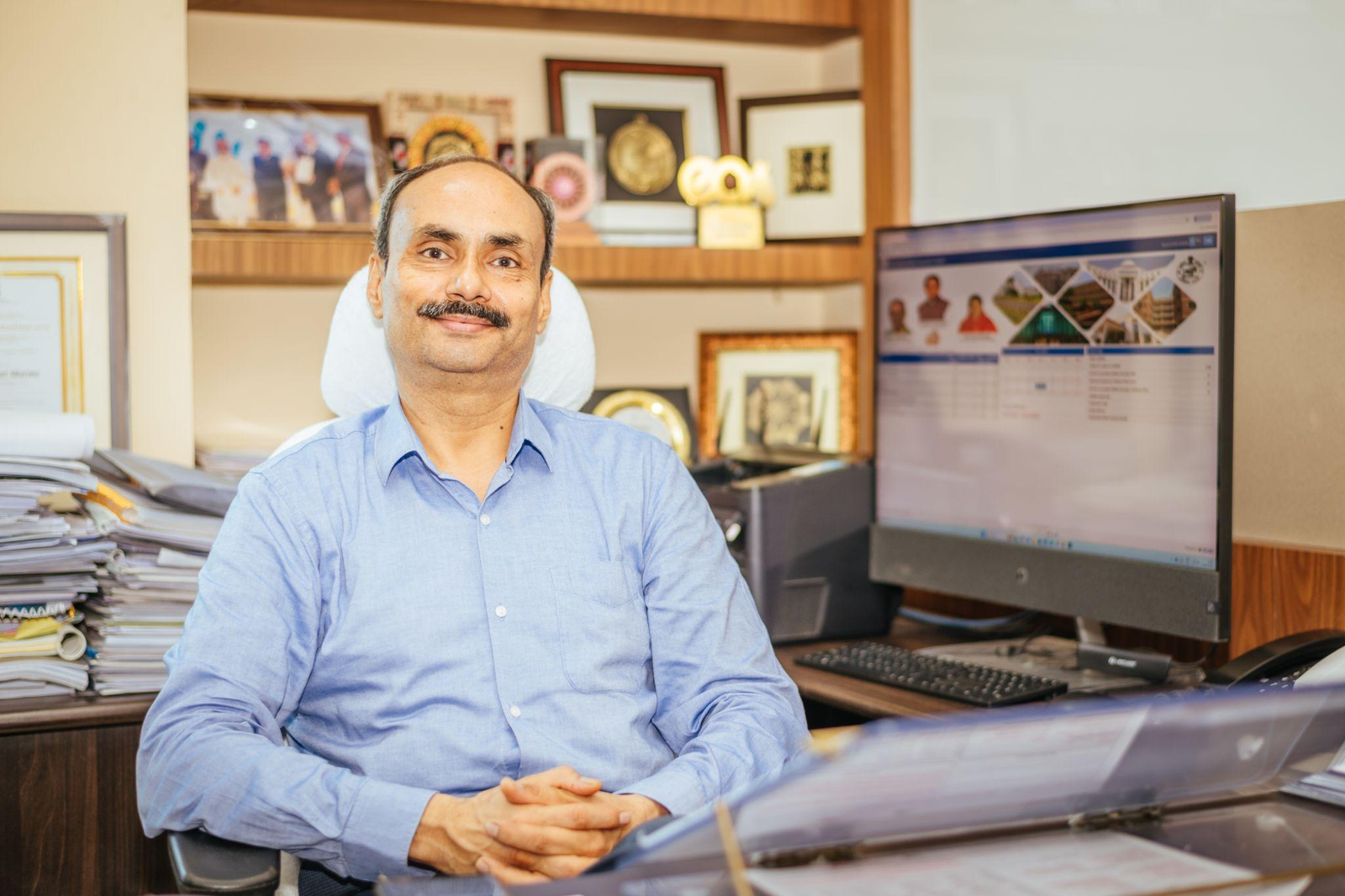
About the Author: Dinesh Kumar Acharya is the Head of the Kennametal Knowledge Center at Kennametal India. With over two decades of experience in the machining and metal cutting industry, he specialises in technical education, process optimisation, and advanced machining strategies.

Head – Kennametal Knowledge Center, Kennametal India Limited