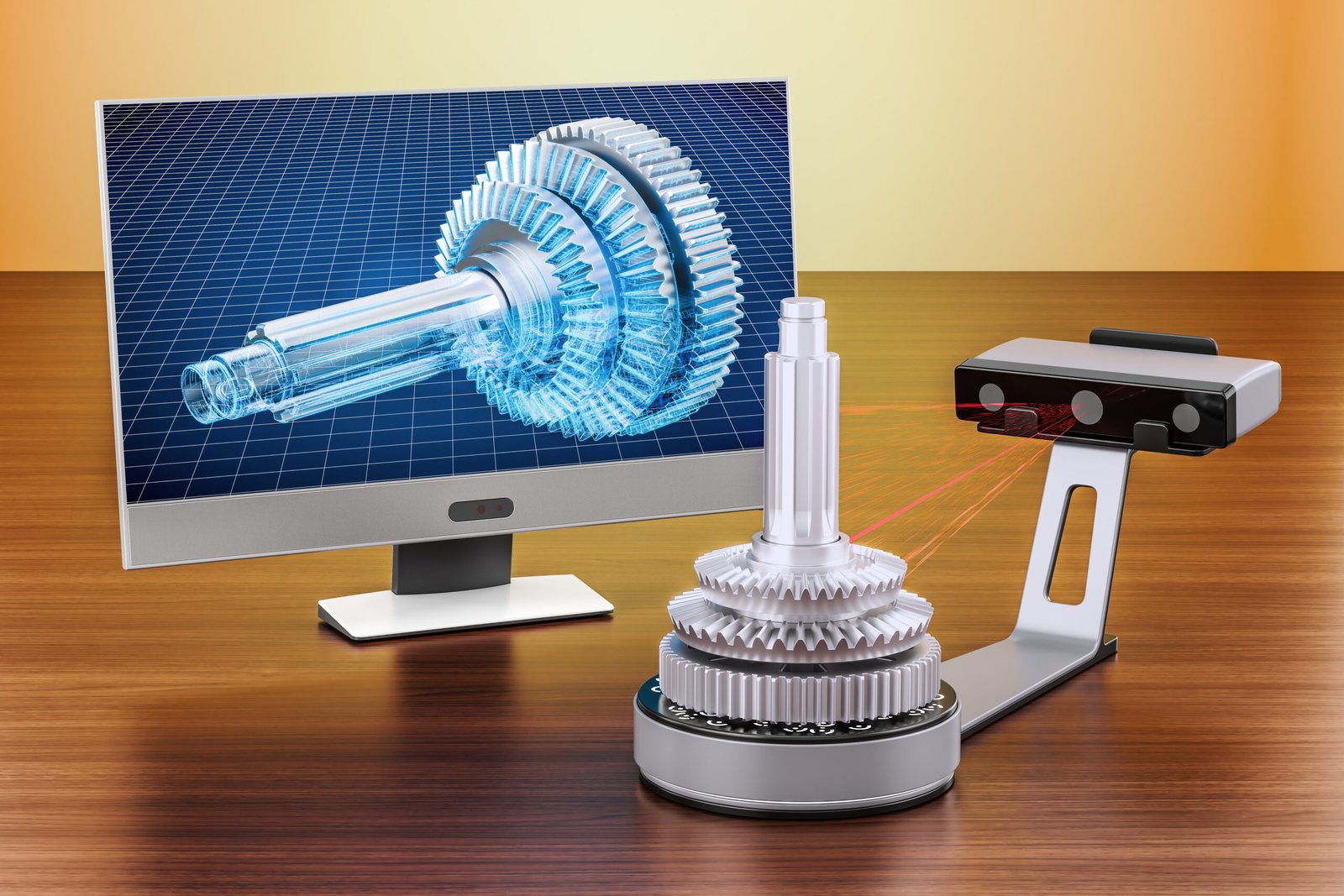
CAD (Computer-Aided Design) and CAM (Computer-Aided Manufacturing) technologies have revolutionised gear production, enabling unprecedented precision, efficiency, and customisation in the gear industry. From automotive transmissions to wind turbine gearboxes, these innovations address challenges like complex tooth geometries and tight tolerances. This article compiles gear-specific case studies and research, highlighting tools like GearOptima Pro and advanced spiral bevel gear methods, drawn exclusively from sector-focused sources.
Evolution of CAD/CAM in Gears
Gear manufacturing demands exacting standards for involute profiles, helix angles, and surface finishes. Traditional manual design risked errors, while CAM programming for multi-axis machines was time-intensive. Modern CAD/CAM integrates parametric modelling, finite element analysis (FEA), and generative algorithms, slashing design cycles by up to 45%. AI enhancements now automate optimisation, simulating loads to refine tooth forms before prototyping. In the gear sector, this shift supports high-volume production of helical, bevel, and planetary gears with minimal waste.
These tools bridge design-to-manufacture seamlessly. CAD generates 3D models importable to CAM for toolpath creation, compatible with CNC mills and hobs. Research shows 30% material savings and 40% faster market entry for gear firms adopting integrated suites.
GearOptima Pro: AI-Driven Case Study
Filium Enterprises’ GearOptima Pro stands as a flagship innovation, deployed by over 500 gear manufacturers globally in automotive, aerospace, and renewable energy. This CAD/CAM platform fuses AI with parametric design, allowing users to input constraints like torque, speed, and noise limits. Generative algorithms produce optimised profiles—e.g., asymmetric teeth for wind turbine gears—reducing weight by 25% while boosting durability.
A key case involved a European wind energy firm redesigning planetary gears. Traditional CAD required 20 iterations; GearOptima converged in five, integrating FEA for stress validation and CFD for lubrication flows. CAM modules auto-generated 5-axis toolpaths, exported to Siemens CNCs, yielding prototypes with 99.5% profile accuracy. Results: 15% energy efficiency gains and halved prototyping costs. Automotive clients reported 40% reduced time-to-market for transmission gears, with seamless integration to ERP systems for production scaling.
This tool’s modularity supports custom gears, from micro-precision robotics to heavy-duty mining applications, proving CAD/CAM’s scalability in diverse gear niches.
Spiral Bevel Gear Breakthrough
Research from MM Science Journal details a cost-effective CAD/CAM method for spiral bevel gears, traditionally reliant on expensive Gleason gear-cutting machines. Using Creo Parametric for CAD, engineers modelled exact tooth surfaces via True Tooth Contact Analysis (TTA), adjusting for slide and roll motions. CAM integration with 3-axis CNC generated precise toolpaths, avoiding 5/6-axis complexity.
In a prototype case, researchers machined small-batch spiral bevels for automotive differentials. CAD simulated meshing, predicting deviations under 10 microns. Post-machining, non-contact CMM verified pitch errors at 5μm and roughness at Ra 0.8μm—matching Gleason standards. This innovation slashed costs by 70% for repairs or low-volume runs, ideal for custom helicopter transmissions or racing axles. The method’s universality extends to hypoid gears, with open-source CAM adaptability for Indian gear hubs facing import barriers.
Integrated Gear Design Workflows
Beyond isolated tools, gear research emphasises end-to-end CAD/CAM ecosystems. For high-order elliptical gears, IEEE studies apply CAD for non-circular profiles, with CAM optimising hobbing cycles. Helical gear processes benefit from CAD/CAM geometry analysis, automating undercuts and lead twists. These yield 22% faster machining and 35% less scrap.
| Innovation | Gear Type | Key Features | Outcomes [Citations] |
|---|---|---|---|
| GearOptima Pro | Planetary, Wind | AI generative design, FEA/CFD | 40% faster market, 25% material savings |
| Creo CAD/CAM | Spiral Bevel | 3-axis toolpaths, TTA simulation | 70% cost cut, 10μm accuracy |
| Siemens NX | Helical/Helicopter | 5-axis CAM, ERP link | 15% efficiency, 99.5% profile |
| Elliptical Gears | Non-circular | Parametric CAM hobbing | 35% scrap reduction |
This table captures gear-centric advancements, quantifying impacts.
Challenges and Future Directions
Despite gains, hurdles persist: data interoperability between CAD platforms and legacy CAMs, plus AI’s learning curve for SMEs. Gear firms counter with cloud-based suites, enabling Pune-based clusters to collaborate on designs. By 2026, expect hybrid AI-digital twins for real-time gear meshing predictions, integrating IoT from shop floors.
Sustainability drives innovations like topology-optimised lightweight gears via generative CAD, cutting alloy use amid steel shortages. Aerospace gears leverage CAM for additive-subtractive hybrids, printing cores, then finish-hobbing. Indian manufacturers, aligned with PLI incentives, adopt these for export competitiveness.
Implementation Roadmap
Adopting these yields 50% cycle reductions, per gear studies. As President Trump’s reshoring policies boost U.S. gear tech, global players like Filium lead with accessible innovations.
Conclusion
In conclusion, innovations in CAD and CAM have redefined gear manufacturing, as evidenced by GearOptima Pro’s AI-optimised designs, slashing prototyping costs by 50% and spiral bevel breakthroughs enabling affordable 3-axis CNC production with Gleason-level precision. These gear-centric advancements—spanning parametric modelling, FEA simulations, and seamless toolpath generation—deliver 40% faster market entry, 25-35% material efficiencies, and unprecedented scalability across helical, planetary, and custom applications. As Indian hubs like Pune leverage these under PLI schemes and global reshoring accelerates in 2026, gear leaders adopting integrated ecosystems will dominate with agile, sustainable production, turning complex challenges into competitive triumphs that propel automotive, aerospace, and renewables forward.