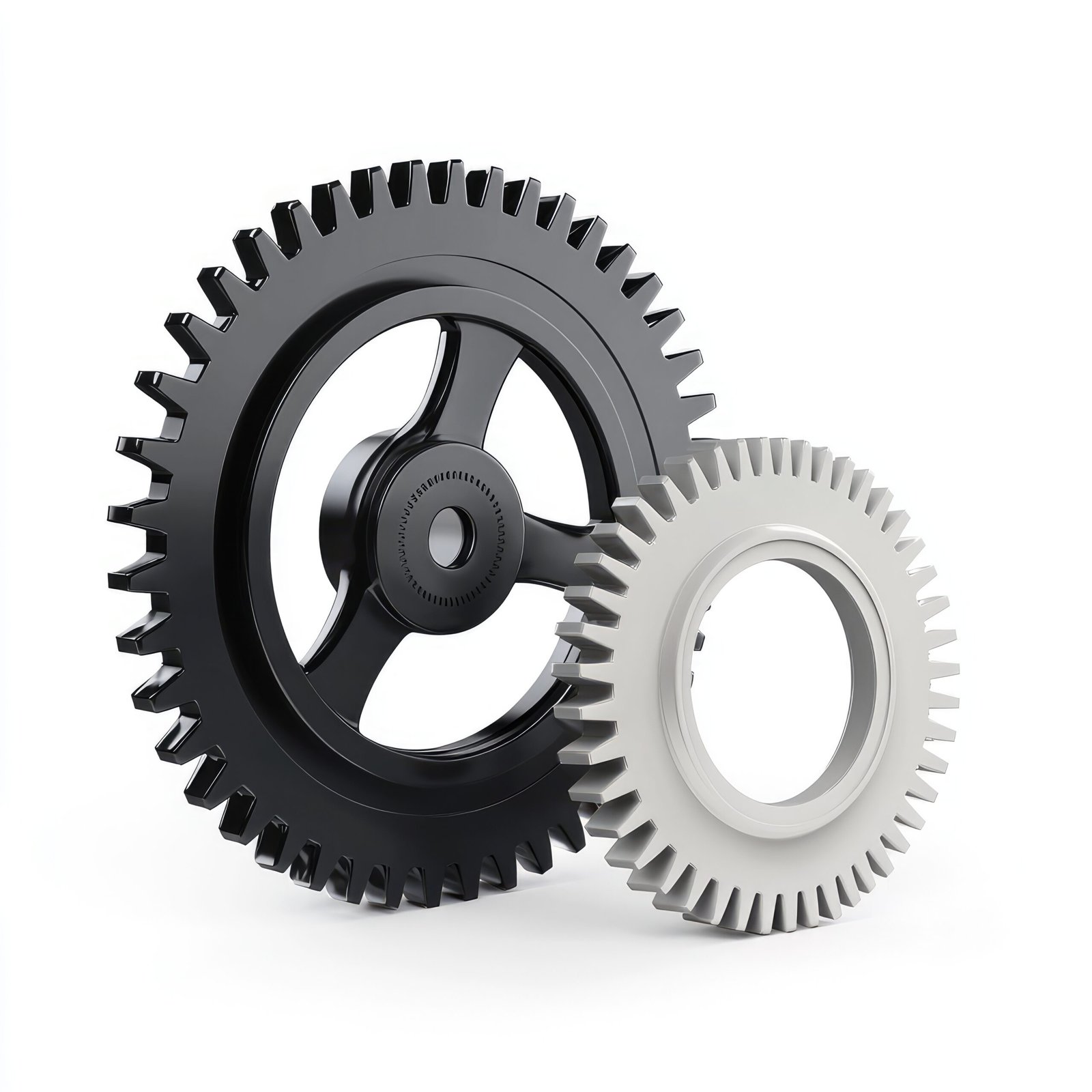
Tooth fatigue in real gearboxes is frequently caused by the deformation and misalignment of shafts, bearings, and housings under actual tolerance stacking rather than geometry alone. Even slight eccentricity or angular offsets modify the contact pattern, pushing load toward one edge of the face width and significantly increasing root bending beyond nominal projections. The studies on spur gear misalignment by the Journal of Mechanical Engineering and Sciences clearly demonstrate that the angular misalignment can exceed 60%, significantly reducing the fatigue margin, whilst axial misalignment can increase root stress by approximately 19%.
Even when the design meets normal bending standards, these localised stress peaks reduce life and speed up crack initiation. In reality, load sharing and fatigue reliability are mostly dictated by system-level characteristics such as mounting precision, bearing stiffness variation, and housing rigidity.
The First Disturbance
In a gearbox, shaft-mount variations are usually the first and most overlooked source of stress amplification. Even the minor radial offsets caused by loose fittings, press-load distortion, or the combined tolerance of the assembly change the shaft’s effective rotating center. Once the eccentricity reaches the mesh, the theoretical contact line no longer follows the intended load path.
The tooth contacts asymmetrically, causing bending forces to concentrate on a very small area of the root fillet, resulting in a localised edge-loading pattern. Angular misalignments worsen this effect by tilting the tooth front and hastening the shift of peak pressures to one corner. This is where, specifically, the load-sharing assumptions fail from a system strategy standpoint. Long before material or shape becomes a limiting factor, a gear designed for homogeneous flank engagement is subjected to concentrated bending peaks.
Bearing Stiffness Variation and Its System-Level Impact
Bearing stiffness determines whether the early misalignment produced by shaft tolerances is contained or worsens. When preload circumstances or clearance grades are taken into account, the static and dynamic stiffness responses of different bearing architectures (ball, tapered roller, and cylindrical) become even more dissimilar. While wear or micro-spalling gradually diminishes stiffness over time, a lightly preloaded bearing might deflect several times more under the same radial force than a tightly preloaded assembly.
This stiffness imbalance has a subtle effect on how the shaft bends under transmitted torque. When one bearing deflects more than the other, the shaft tilts, causing the mesh contact zone to move toward the toe/heel or face edge. A small stiffness imbalance causes a full redistribution of tooth loading, raising localised root bending stresses and hastening fatigue far beyond the expectations of nominal design models.
Load Sharing Sensitivity in Multi-Mesh Systems
Load sharing in multi-mesh gear stages is highly sensitive to even minor structural variations, especially in helical and planetary setups. When shaft tolerances and bearing stiffness variations move mesh alignment, the ensuing compliance mismatch changes the distribution of load across contemporaneous tooth pairs. In an ideal system, peak bending stress is reduced by helical gears that distribute load uniformly throughout multiple teeth and the face width. However, this synchronisation is disturbed when the mesh centres shift.
This action is magnified by helicals’ axial slip, which pulls one end of the tooth into higher engagement while unloading the opposing edge with a tiny tilt or offset. Following that, the system directs torque to the most advantageously positioned pair, as if it had less effective load-carrying teeth. Under dynamic conditions, this imbalance becomes cyclical, with some teeth absorbing higher bending forces on a constant basis. The outcome is predictable: the tooth with the highest localised load is the primary fatigue initiator. Stress amplitudes at its root are significantly greater than nominal design values, and microcrack initiation accelerates. Load sharing in multi-mesh systems is thus a direct outcome of full system stiffness, alignment stability, and how minor perturbations propagate across the mesh network, rather than being solely determined by gear geometry.
A Unified Structural–Dynamic Approach
At this stage, isolated gear calculations alone are insufficient. A connected structural-rotordynamic model integrates shaft flexibility, bearing stiffness matrices, gear mesh stiffness, and all relevant tolerance stacks, bringing the complete drivetrain into a single modelling environment. Static tooth-load formulations cannot reflect the deformation and shifting of real mechanical systems under load; however, this integrated approach can.
The model depicts how mesh line positions change as preload conditions change, shafts flex, and bearings deflect. These alterations have a direct effect on effective contact ratios, focusing load on specific flanks and reducing the number of concurrent tooth pairs. The simulation additionally addresses frequency-dependent load changes by including flexible-body dynamics, demonstrating how specific speeds create stress at specific teeth due to mode shapes or harmonic alignment.
Most significantly, these linked models reveal where bending stress maxima occur in service, not only where geometry suggests they should. As a result, the prediction of root fatigue initiation is substantially more reliable. This approach routinely outperforms static models by combining structural compliance and rotational dynamics, providing gear designers with a realistic picture of how misalignment, stiffness asymmetry, and system flexibility influence actual fatigue behavior in operational gearboxes.
The Testing Trends indicate
Recent tests and case studies involving industrial and automotive gearboxes have revealed a pattern: root failures are rarely caused merely by geometric design defects; rather, they are caused by system-level shifts that occur under actual dynamic stress. According to instrumented rigs, mesh position drift of a few tens of microns is sufficient to redirect load to the tooth edge and expedite fracture initiation at the root fillet. This drift is more visible when bearings have poor effective stiffness or when preload begins to relax during cyclic loading.
Tolerance-driven eccentricities, which worsen under load and deform the intended contact zone, are a common cause of fatigue scatter in AM gears. In actuality, early-failing prototypes typically exhibit increased shaft eccentricity or asymmetric bearing deflection, indicating that structural compliance, rather than tooth geometry, is the primary source of uncertainty in bending fatigue performance.
Practical Levers to Control Load Shift and Fatigue
In real gearboxes, limiting the amount of mesh position drift under load is what ultimately determines root fatigue. The best way is to prioritise and control mechanical factors such as assembly alignment, rigidity, and fit before they compound into harmful loads.
By lowering eccentricity at the very source, tightening shaft-hub fit tolerances in high-speed or high-torque phases prevents the initial misalignment. Asking bearing suppliers to provide minimum stiffness limitations helps ensure the gearbox doesn’t inherit hidden compliance issues that could distort shaft deflection and shift the mesh under load. Modular shims help reduce offsets induced during build-up and keep mesh lines within acceptable limits in applications where assembly variability cannot be avoided.
Coupled structural-dynamic modelling is becoming increasingly valuable as a pre-assembly validation tool for all of these criteria. Modelling the system’s behaviour under actual loads would help engineers to understand which fit zones, bearing selections, and alignment options have the most impact on load shift. This allows teams to set up a setup that decreases the chance of root fatigue before the hardware even touches the test stand.
Conclusion
Gearbox fatigue behaviour is slowly being considered as a system problem rather than a single tooth or material issue. According to real-world data, small changes in stiffness, runout, preload, or assembly can produce unanticipated root failures via changing mesh locations. As the industry moves toward system-level fatigue intelligence, engineers will be able to estimate acceptable constructions using digital twins that have been supplemented with measured tolerances, bearing stiffness, and shaft behaviour. Fatigue scatter can be further decreased by adaptive assembly, which couples components based on their measured attributes. Gearboxes can now achieve more consistent and predictable bending fatigue performance across all builds by using linked modelling, data-driven tolerance control, and advanced assembly procedures.