In the aerospace industry, where precision, reliability, and safety are paramount, long-term partnerships built on trust and innovation often become the foundation of technological progress. One such enduring collaboration is that between German grinding machine manufacturer KAPP NILES and American vertical-lift aircraft pioneer Bell Textron Inc. For more than four decades, the two companies have worked together to overcome complex manufacturing challenges, setting new benchmarks in aerospace gear production.
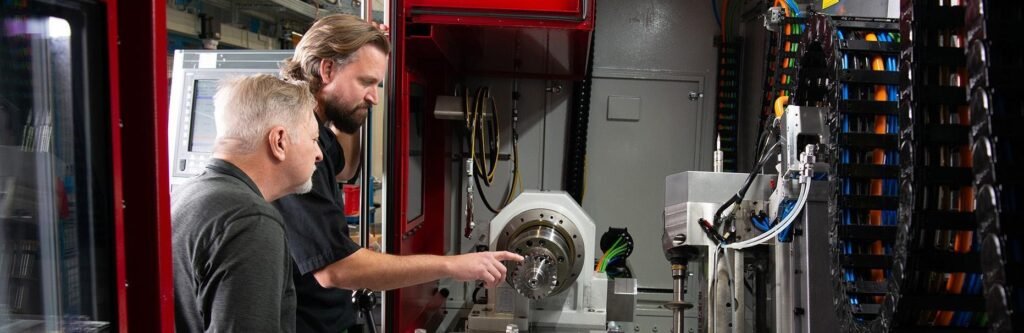
Bell has been at the forefront of aviation innovation since 1935. Renowned for its helicopters and tiltrotor aircraft, the company serves a diverse range of sectors, including civilian transportation, emergency medical services, search and rescue, and military operations. Many of Bell’s aircraft operate in some of the world’s most demanding environments, where component reliability is not merely desirable—it is essential.
“Bell is an innovative, very quality-conscious company. We make the finest gears in the world, and we depend on KAPP NILES machines to do that,” says Kyle Kendall, Principal Equipment Engineer at Bell.
The company’s uncompromising focus on quality stems from a simple but critical objective: ensuring that customers return safely home after every mission.
The relationship between Bell and KAPP NILES dates back to the late 1980s, when Bell acquired a VAS-type grinding machine, a predecessor to today’s VX series. These profile grinding machines were specifically suited to aerospace applications, where extremely tight tolerances are mandatory.
Throughout the 1990s and 2000s, Bell expanded its manufacturing capabilities by installing nearly a dozen additional KAPP NILES machines. Remarkably, many of these machines remained operational for more than three decades.
“When your machines last over 30 years, that’s a pretty good stamp of approval for a quality machine,” Kendall remarks.
As production requirements evolved, Bell gradually modernised its facilities by replacing older machines with new VX 59 models. The decision was straightforward. The longevity and performance of the earlier systems had already proven their value.
Scott Phillips, machinist at Bell, highlights the versatility of the VX machines: “All our helicopter models from the past four decades have been fitted with gears ground on KAPP NILES machines. Most of these parts are now produced on VX 59s within the tolerances we expect.”
The latest VX generation incorporates advanced features such as an optional zero-point clamping system, significantly reducing setup times for grinding spindles and auxiliary grinding heads. Bell reports setup time reductions of approximately 85 per cent, while also eliminating operator-to-operator variability through a more standardised, plug-and-play approach.
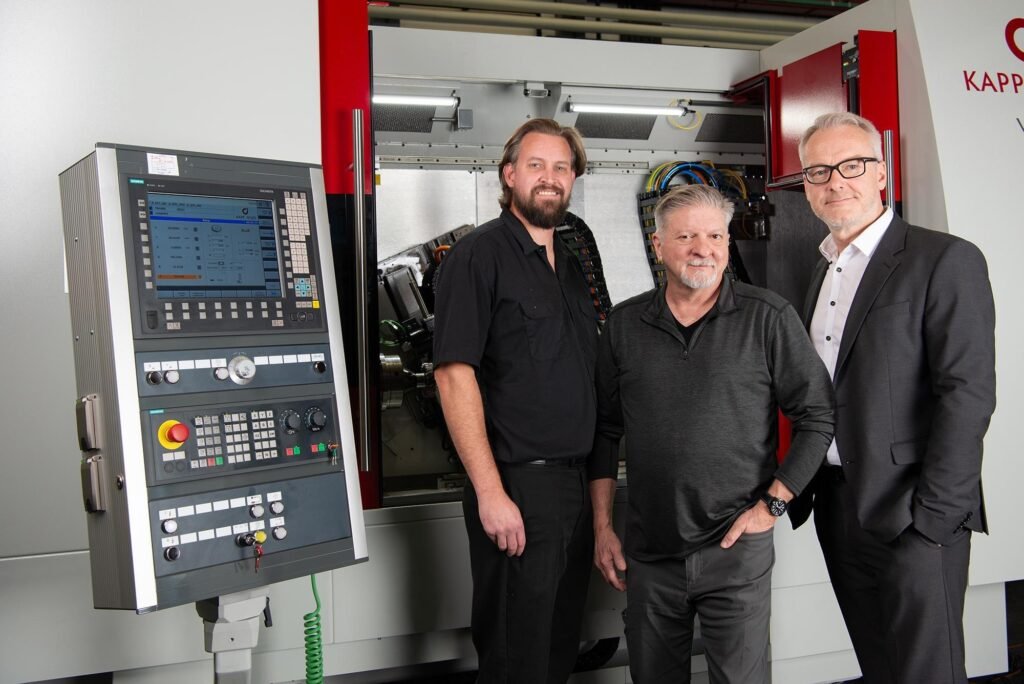
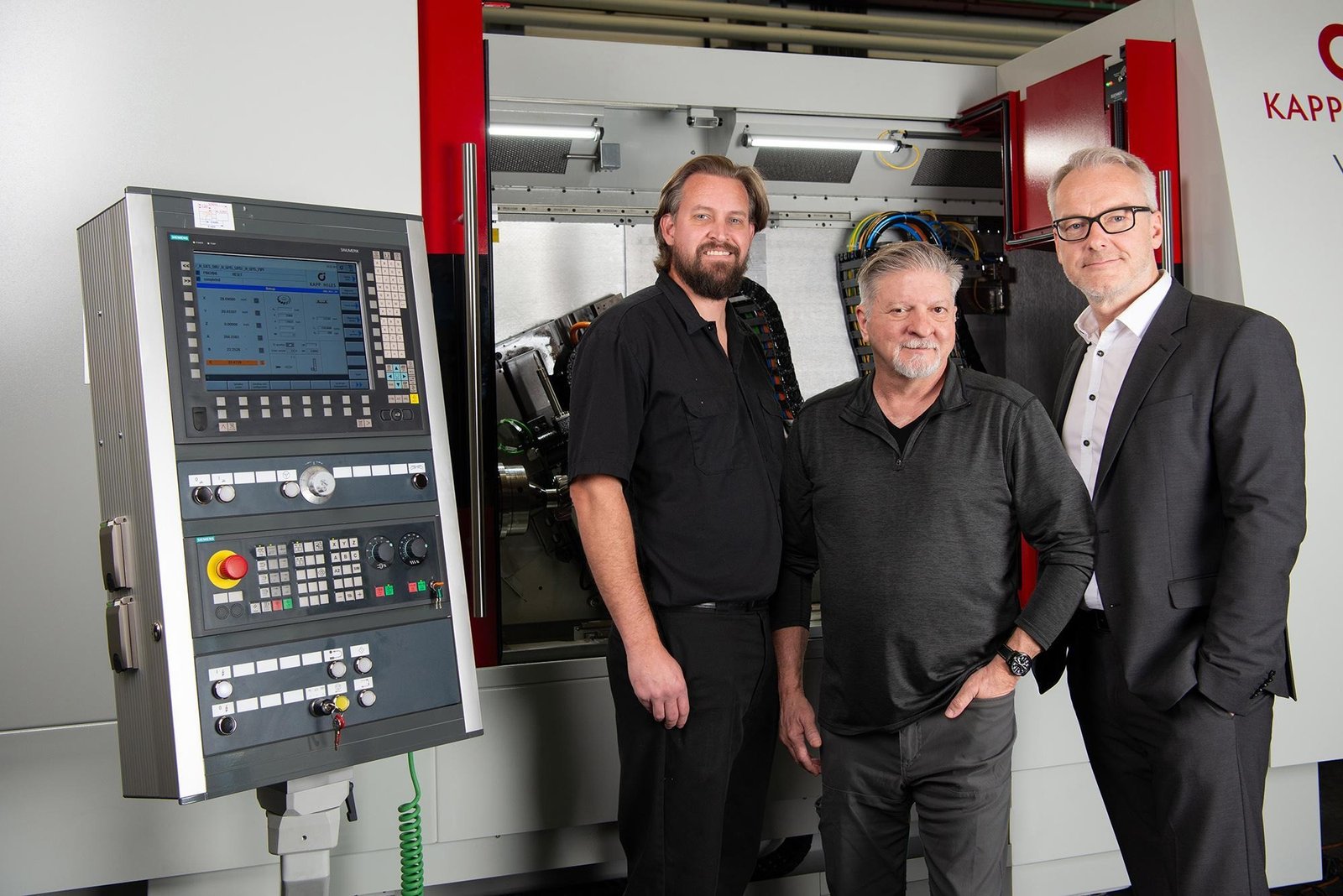
Machinist Scott Phillips, Principal Equipment Engineer Kyle Kendall (both from Bell), and Area Sales Manager Arnt Lachetta during the pre-delivery inspection of a VX 59 from KAPP NILES at the company headquarters in Germany.
While machine reliability remains crucial, Bell values another equally important aspect of its relationship with KAPP NILES—responsive service and technical support.
One of the most transformative outcomes of this collaboration emerged during the 1990s with the development of the integrated measurement system known as AMS.
Bell initially approached KAPP NILES with a requirement for a machine-integrated solution capable of measuring and documenting gear characteristics directly on the grinding machine. Working closely together, both companies developed the AMS functionality, which has since become an industry-leading solution.
The system employs an onboard Renishaw measuring device to inspect multiple points along the profile and lead direction of a gear, both before and after grinding. This ensures that every gear surface is correctly finished while preventing excessive removal of material from the hardened layer.
“AMS was an important development. Pretty much every gear that we grind nowadays is AMSed,” says Phillips. “It brings reliability and significant time savings. As we’ve been using AMS for more than 30 years, the time saved isn’t measured in hours or days, but in months.”
The success of AMS has extended well beyond Bell’s facilities. The concept has gained widespread acceptance across the aerospace sector, helping establish new standards for integrated process control and quality assurance.
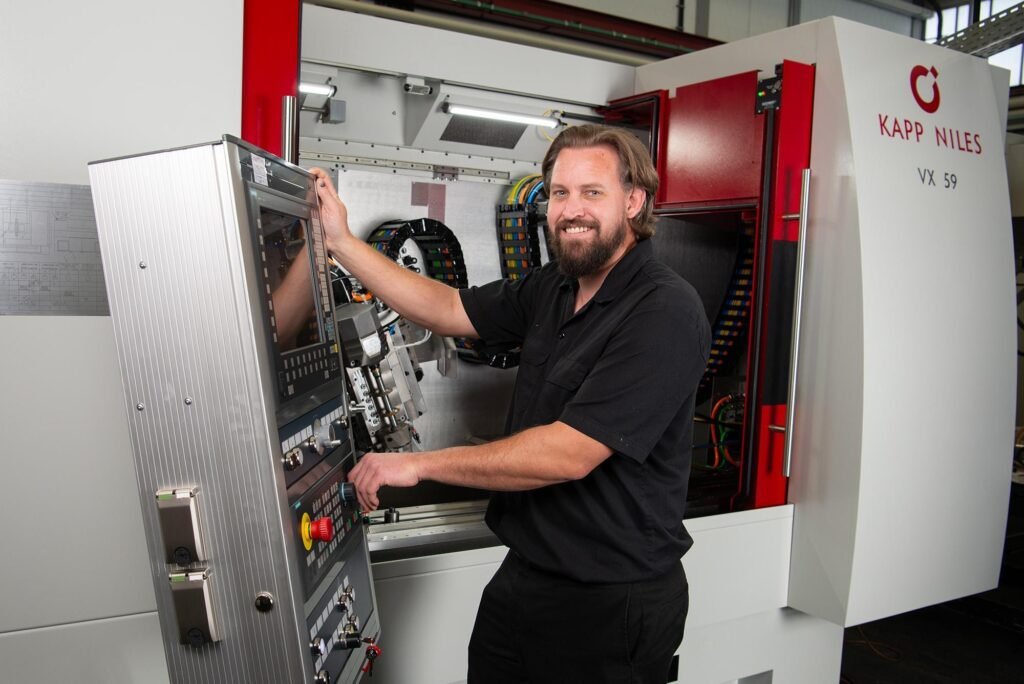
“Thanks to the AMS function developed for us, we can measure workpieces directly on the machine – saving months of time over the past 30 years,” says machinist Scott Phillips.
Five years ago, Bell further expanded its machining capabilities by investing in a KX 500 FLEX machine, marking the company’s first venture into generating grinding technology.
Bell sought a solution capable of increasing productivity for planetary gears produced in relatively large batches while maintaining the stringent quality requirements mandated by aerospace applications. However, existing production regulations required final finishing through CBN profile grinding.
KAPP NILES responded with an innovative hybrid approach. Using the KX 500 FLEX, rough machining is performed through generating grinding, dramatically reducing machining times, while final finishing is completed using CBN profile grinding wheels to achieve the required surface quality.
The results have been significant.
“Changing from profile grinding to a combination with generating grinding has been a game changer,” Phillips explains. “We’ve reduced runtime by about 70 per cent, which is huge. At the same time, the KX 500 FLEX is very consistent. We’re saving a lot of time without losing the quality we’re accustomed to.”
Encouraged by the machine’s performance, Bell is already considering the addition of a second KX machine.
Bell’s KAPP NILES machine fleet also includes two systems from the KNG master series, specifically designed for large gears and heavy workpieces.
According to Phillips, combining multiple machine platforms enables Bell to optimise final gear machining for every component. “Having the right machine type for every workpiece is key to success,” he says.
Supporting this extensive installed base is KAPP TECHNOLOGIES L.P., the company’s U.S. subsidiary based in Boulder. The local presence is particularly valuable given the strict requirements imposed by U.S. ITAR regulations, which limit access to certain technical information. Additionally, local manufacturing of tools significantly reduces delivery times and enhances service responsiveness.
The collaboration between Bell and KAPP NILES extends beyond supplier-customer dynamics. It represents a partnership in which both organisations continually challenge each other to innovate.
“Sometimes Bell comes with requirements that are challenging for us,” says Arnt Lachetta, Area Sales Manager at KAPP NILES. “These tasks push us to our limits—and beyond. This is incredibly valuable because we not only support our partner, but also grow through these challenges ourselves.”
KAPP NILES acknowledges that Bell’s demanding requirements have played an important role in strengthening its capabilities and establishing its position as a leader in aerospace gear grinding technology.
For Bell, the relationship is built on shared values and mutual commitment.
“We set high standards for ourselves and our products. That’s why we sometimes require special solutions,” says Kendall. “Bell does unique things, and we need a partner who truly cares. With KAPP NILES, we feel supported by a team that values our goals and growth as much as we do. We know we can rely on them, and that’s why we keep coming back.”
As aerospace manufacturing continues to evolve, the Bell-KAPP NILES partnership stands as a compelling example of how collaboration, innovation, and a relentless pursuit of excellence can transform industry challenges into lasting success.
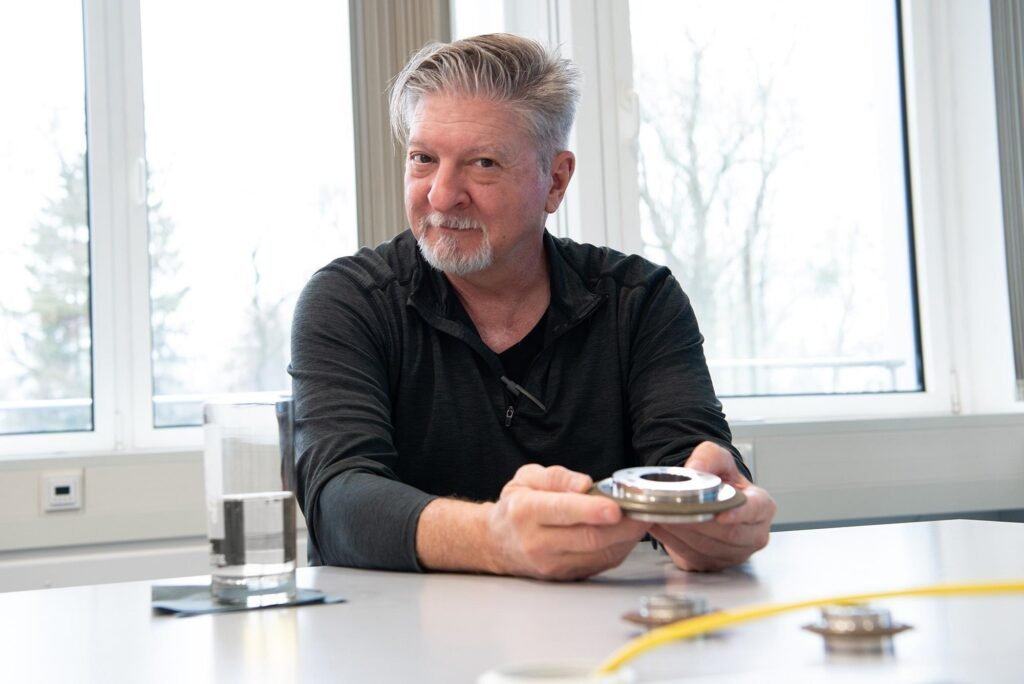
“Bell is an innovative, very quality-conscientious company. We make the finest gears in the world”, emphasises Kyle Kendall, Equipment Engineer at Bell, with a CBN tool in his hand.