Currently 91% of Indian businesses recognise the urgent need for digitisation, with consistency and quality control cited as the main motivators. Although many Indian SME gear manufacturers currently commit to automation and measuring technology, the budget is still less than 10%.
The consequences of these errors are costly. A top gearbox manufacturer estimated that 15% of rework occurs as a result of manual inspection limitations and uneven gear quality. A significant part of this can be due to finish variability, with cylindrical grinding acting as the primary last line of defence.
In wind, automotive, EV, and aerospace gears, micron-level variations can cause noise, short lifecycles, or expensive failures. failures. With global benchmarks tightening and skilled labour shrinking, automation in grinding via in-process gauging, auto-compensation, CNC, and closed-loop systems is no longer optional but essential.
Automation Drivers in Gear Grinding
Indian gear shops are changing as an outcome of the shift to Industry 4.0. IMTMA says that OEM demands for increased repeatability and tolerances have led to about 60% of machine tool users in India already exploring digital and smart manufacturing upgrades. Gears with ±2–3 micron uniformity across batches are expected by international customers, but this is difficult to achieve with operator-dependent methods.
The difficulties on the shop floor are obvious: relying on highly skilled grinders is no longer feasible due to the industry’s shrinking skilled talent and labour, manual gauging adds unpredictability, and inspection loops slow down output. Automation handles these issues head-on. With in-process measuring and CNC-driven repairs, faults are detected in real time, eliminating the costly rework loop. Automation is more than just a driver of efficiency for Indian gear makers trying to balance cost demands with global quality criteria; it is the foundation of repeatable precision at scale.
In-Process Gauging: Real-Time Accuracy
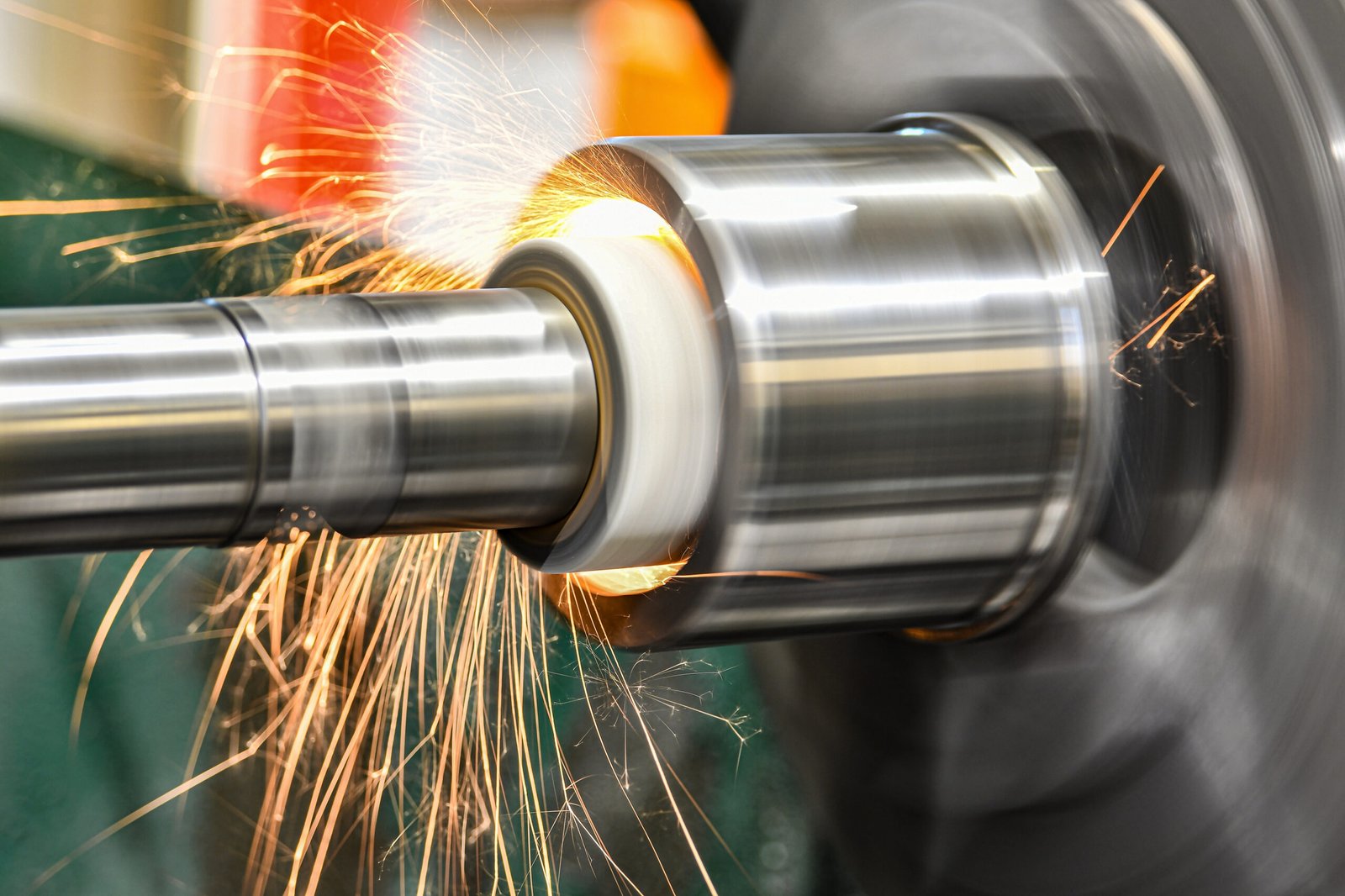
In-process gauging gives the machine constant feedback by monitoring workpiece measurements while grinding using touch or non-contact sensors. It is proved to be quite useful for controlling factors like thermal expansion on gear shafts during longer cycles that are usually missed by routine inspections. When you do away with human checks and trial grinding, it guarantees that bore sizes and ODs remain consistent throughout high-volume runs.
These gauges have already been integrated into CNC cylindrical grinders by Tier-1 Indian automakers, providing micron-level accuracy with little operator involvement. Faster cycles, lower rejection rates, and repeatability, all of which manual inspection just cannot provide, are the ultimate results.
Benefits:
Auto-Compensation Systems
For many years, the ability of skilled operators to “feel” adjustments in the process was the main tool of cylindrical grinding in India. But the model breaks down when tolerance windows get smaller. When deviations occur, auto-compensation modifies wheel feed by using precise, sensor-driven corrections in place of subjective human input. This lowers the learning curve for beginner operators and keeps tolerances below ±2 microns. Auto-compensation, which makes consistency the responsibility of the machine rather than the human, is becoming a game changer in clusters like Pune and Rajkot, where suppliers serve export markets.
CNC Advancements in Cylindrical Grinding
For many years, the ability of skilled operators to “feel” adjustments in the process was the main tool of cylindrical grinding in India. But the model breaks down when tolerance windows get smaller. When deviations occur, auto-compensation modifies wheel feed by using precise, sensor-driven corrections in place of subjective human input. This lowers the learning curve for beginner operators and keeps tolerances below ±2 microns. Auto-compensation, which makes consistency the responsibility of the machine rather than the human, is becoming a game changer in clusters like Pune and Rajkot, where suppliers serve export markets.
Closed-Loop Quality Assurance
Every gear manufacturing line was slowed by the inspection bottleneck that was created by sending gears from the grinder to the CMM lab and back again if they weren’t up to standard. By feeding CMM or in-machine data straight into the CNC, closed-loop grinding systems close the loop and allow rapid, automated repairs. This minor change has increased first-pass output and freed up capacity for Indian OEM suppliers by reducing inspection-to-correction times by 30–40%. Connecting grinders to MES/ERP systems for predictive quality control across the entire factory presents the true opportunity. Gear plants will integrate quality control into the production flow by preparing for deviations rather than responding to them.
Indian Gear Industry Context
Despite decades of machining experience in clusters like Pune, Chennai, and Rajkot, there is a significant amount of manual intervention and a dispersed use of gauging, auto-compensation, and CNC automation. The industry is also evolving: export contracts demand more stringent PPAP compliance, while EV drivetrains demand gears with tighter tolerances and almost zero noise. Local machine tool manufacturers are beginning to provide retrofit automation kits, which enable legacy grinders to meet these new performance requirements without necessitating a complete machine replacement. Government initiatives like PLI and Make in India are also encouraging businesses to modernise. The gap between current capabilities and expectations around the world is evident, but so is the path forward.
Roadmap for Smart Upgrades in Indian Gear Grinding
A phased adoption strategy could work just optimally for the Indian gear shops. It will ensure operational continuity and return on investment:
Reduced scrap rates, less reliance on staff, higher throughput, and a quicker time to market are just a few of the obvious advantages. Even little improvements can raise a shop’s output to global standards, positioning it for both domestic EV demand and export potential.
Conclusion
Operator proficiency alone is no longer enough and shouldn’t be a scale of precision in today’s gear world. Automation reduces production cycles, removes rework, and offers repeatable quality at scale, from closed-loop control to in-process measuring. Adopting cylindrical grinding automation is more than just a technological update for Indian gear shops searching for global supply chains; it is a strategic necessity. Modernisation has improved a company’s ability to meet OEM requirements, compete with global rivals, and prepare for the expanding needs of the EV, aerospace, and renewable energy sectors.