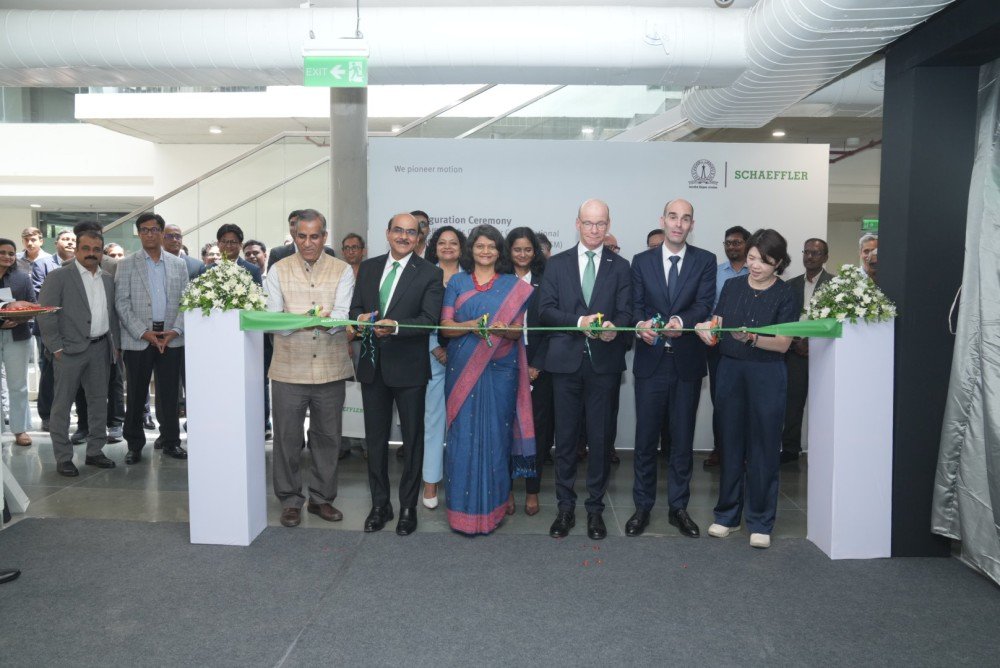
Reinforcing its commitment to advancing research and innovation in India, Schaeffler India has announced the inauguration of a state-of-the-art computational research infrastructure at the Foundation for Science Innovation and Development (FSID) at the Indian Institute of Science (IISc), Bengaluru.
The initiative, supported through Schaeffler India’s CSR programme HOPE, is aimed at enhancing FSID’s computational capabilities to enable high-performance computing (HPC), large-scale simulations, data-intensive modelling, and advanced analytics across key domains such as materials engineering, energy systems, and sustainable mobility.
The upgraded facility includes dedicated laboratory space, advanced in-rack cooling systems, power backup infrastructure, and high-performance hybrid computing workstations and clusters. These additions are expected to significantly improve computational efficiency while supporting cutting-edge scientific research and technology development.
The enhanced infrastructure will directly benefit IISc faculty members, FSID-incubated startups, external startups, MSMEs, and industry partners involved in collaborative R&D projects. Indirect beneficiaries include PhD scholars, postgraduate and undergraduate students, postdoctoral researchers, and the wider academic and industrial ecosystem.
In a further step toward strengthening industry-academia collaboration, Schaeffler India has also signed a Master Research Agreement (MRA) with IISc, laying the groundwork for multiple future research projects.
Commenting on the development, Harsha Kadam, Managing Director and CEO of Schaeffler India, said that strong collaboration between academia and industry is essential for building skills and manufacturing excellence aligned with India’s future needs. He noted that the new facility would support a broad range of IISc research initiatives while accelerating the execution of a growing pipeline of joint projects between Schaeffler India and the institute.
Highlighting the significance of the initiative, Sai Gautam Gopalakrishnan stated that the long-term vision is to establish a computational facility with a peak performance of approximately 32 PFLOPs, leveraging a combination of CPUs and GPUs. He emphasised that the facility would play a crucial role in advancing digitalisation, automation, and accelerated research across the IISc ecosystem while supporting startups and industry collaborators.
B. Gurumoorthy, Director of FSID, described the collaboration as an important milestone in strengthening the institution’s capabilities in high-end simulations, data-intensive research, and interdisciplinary innovation. He added that the initiative exemplifies how industry-academia partnerships can accelerate the development of technologies with real-world relevance.
By enhancing FSID’s computational infrastructure, Schaeffler India aims to catalyse agile and impactful research, accelerate scientific outcomes, develop future-ready talent, and drive industry-relevant solutions in emerging engineering domains.
Part of the global Schaeffler Group, Schaeffler India operates five manufacturing plants, three R&D centres, and an extensive sales and aftermarket network across the country. With a workforce of over 3,800 employees and more than six decades of presence in India, the company continues to play a significant role in advancing motion technology solutions for mobility and industrial applications.