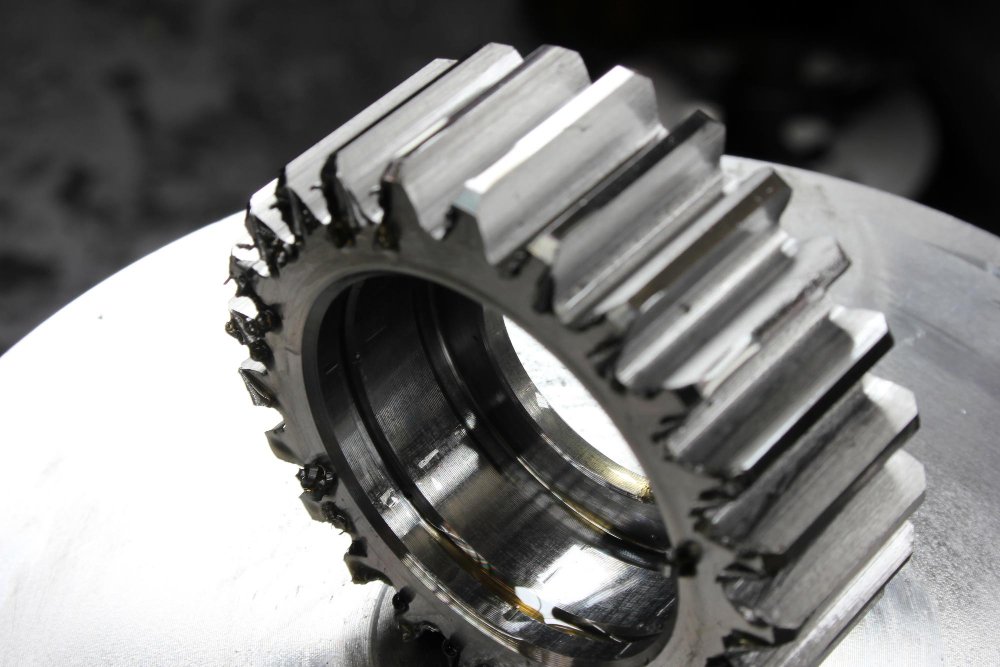
In modern gear manufacturing, grinding is no longer a simple finishing operation; it is a defining process that directly influences noise behaviour, fatigue life, efficiency, and ultimately the competitiveness of the final product. As drivetrain designs evolve toward higher power density, lower mass, and stricter NVH requirements, particularly in electric vehicles, the limitations of conventional grinding abrasives are becoming increasingly difficult to ignore. What was once “good enough” for internal combustion drivetrains now exposes variability, thermal damage, and economic inefficiencies when pushed to today’s performance thresholds.
For decades, Aluminum Oxide and Silicon Carbide grinding wheels formed the backbone of cylindrical and gear grinding. They were affordable, familiar, and compatible with existing machine tools. However, as hardened gear steels such as 16MnCr5, 20MnCr5, 8620, and 9310 became standard and as case depths, hardness levels, and profile accuracy requirements increased, the industry reached a point where conventional abrasives began limiting productivity rather than enabling it. This has shifted the conversation from what Cubic Boron Nitride (CBN) is to a far more practical and consequential question: when does switching to CBN make technical and economic sense?
Understanding the Material Advantage: Why CBN Behaves Differently
The fundamental reason CBN outperforms conventional abrasives lies at the material science level. Aluminium Oxide, with a Knoop hardness of roughly 2,100 HK, relies on micro-fracturing to generate fresh cutting edges. Under moderate conditions, this works well, but when grinding hardened steels above 55 HRC, the abrasive grains dull faster than they fracture. The result is glazing, increased friction, rising grinding forces, and excessive heat generation at the contact zone.
CBN, by contrast, operates under a fundamentally different wear mechanism. With a Knoop hardness approaching 4,700 HK, second only to diamond, it resists plastic deformation and maintains sharp cutting edges under extreme contact pressures. More importantly for ferrous applications, CBN remains chemically stable at temperatures where diamond would rapidly degrade. Diamond’s carbon structure reacts with iron at elevated temperatures, leading to graphitisation and chemical wear. CBN does not suffer from this limitation, remaining inert to ferrous alloys at temperatures exceeding 1,300°C.
This chemical stability allows CBN wheels to operate at significantly higher peripheral speeds and material removal rates without sacrificing wheel life or surface integrity. In high-performance gear grinding, this capability is not merely a productivity advantage; it is the foundation for process stability.
Thermal Behaviour: The Hidden Driver of Grinding Quality
Grinding is fundamentally a thermally intensive process. A large portion of the energy input is converted into heat, and how that heat is distributed determines surface integrity, residual stress, and microstructural stability. Conventional abrasive wheels tend to act as thermal insulators. Heat generated at the cutting interface is pushed into the workpiece, increasing the risk of grinding burn, tempering, and the formation of untempered martensite, commonly referred to as the “white layer.”
CBN behaves differently due to its exceptionally high thermal conductivity, nearly 40 times higher than Aluminum Oxide. Rather than forcing heat into the gear tooth, a CBN wheel acts as a thermal sink, drawing heat away from the contact zone and into the wheel body and coolant stream. This fundamentally alters the thermal gradient within the material, reducing peak temperatures at the surface even when operating at higher removal rates.
The practical implication is profound. Lower thermal load means reduced risk of burn, more consistent microhardness profiles, and a far more predictable residual stress state. For gears subjected to cyclic loading, this difference directly translates into improved pitting resistance, bending fatigue life, and long-term reliability.
When Conventional Abrasives Reach Their Limit
The transition to CBN is rarely justified for soft materials or low-volume production. Below approximately 45–50 HRC, conventional abrasives remain more economical and forgiving. However, once gears are case-hardened to 58–62 HRC, particularly with deeper case depths, the behaviour of Aluminum Oxide wheels changes dramatically. Dressing frequency increases, wheel wear accelerates, and dimensional drift becomes a constant challenge.
Each dressing cycle removes abrasive material, alters wheel geometry, and introduces variability into the process. In gear grinding, where involute accuracy, lead correction, and profile consistency are critical, this variability quickly becomes unacceptable. Frequent compensation at the machine control level can only mask the problem to a certain extent.
CBN’s resistance to wear allows the wheel to maintain its form over hundreds or even thousands of parts. This form stability is especially critical for high-precision applications such as automotive transmission gears, e-axle reduction gears, and aerospace gearboxes, where even micron-level deviations can influence noise and efficiency.
Surface Integrity and Residual Stress: The Real Performance Metric
Modern gear design increasingly prioritises surface integrity over simple dimensional accuracy. Residual stress state, surface roughness orientation, and microstructural consistency now play a decisive role in gear durability. Conventional grinding, especially under aggressive conditions, tends to induce tensile residual stresses due to localised overheating. These tensile stresses act as crack initiation sites under cyclic loading.
CBN grinding, by virtue of lower grinding forces and reduced thermal input, consistently produces compressive residual stress profiles. Compressive stress delays crack initiation and propagation, significantly improving fatigue performance. In high-load EV applications where torque is instant and cyclical loading is severe, this difference can determine whether a gearbox meets its design life or fails prematurely.
The G-Ratio: Quantifying Process Stability
One of the most revealing metrics when comparing abrasives is the G-ratio, defined as the volume of material removed divided by the volume of wheel wear. Conventional wheels typically achieve G-ratios between 50:1 and 150:1. While acceptable for many applications, this level of wear introduces continuous geometric change and frequent downtime.
Vitrified CBN wheels routinely achieve G-ratios in the range of 5,000:1 to 10,000:1. This means the wheel removes thousands of times more material than it loses, effectively locking in geometry for extended production runs. For gear grinding, this translates into consistent tooth profiles, reduced need for in-process corrections, and dramatically lower variability across large batches.
Economic Reality: Moving Beyond Wheel Cost
The most common objection to CBN adoption is its upfront cost. A single CBN wheel may cost 20 to 50 times more than a conventional wheel, creating immediate resistance from purchasing-driven decision models. However, this perspective fails to account for the broader economics of grinding operations.
Grinding cost is not dominated by tooling; it is dominated by time, labour, machine utilisation, and quality losses. CBN enables significantly higher wheel speeds and material removal rates, often reducing cycle times by 30–50%. Over thousands of parts, this alone can outweigh the initial tooling investment.
Downtime is another hidden cost. Conventional grinding requires frequent dressing and wheel changes, often interrupting production multiple times per shift. CBN wheels can remain in the machine for weeks or months, dramatically improving overall equipment effectiveness (OEE).
Quality-related costs further tilt the balance. Scrap due to burn, rework caused by size drift, and increased inspection frequency all carry financial penalties that are rarely captured in tooling comparisons. CBN’s stability reduces these risks, making process outcomes more predictable and controllable.
Machine Tool Compatibility: Why Infrastructure Matters
CBN is not a drop-in replacement for conventional abrasives. To unlock its benefits, the grinding machine must meet certain performance thresholds. High wheel speeds and elevated material removal rates demand excellent spindle rigidity and dynamic stiffness. Any vibration or chatter not only degrades surface finish but can also cause micro-fracturing of the CBN grains, shortening wheel life.
Coolant delivery becomes critical at high speeds. The air barrier created by a fast-rotating wheel must be penetrated by high-pressure, well-directed coolant jets to ensure effective cooling and chip evacuation. Poor coolant application is one of the most common reasons CBN trials fail, leading to wheel loading and thermal damage despite the abrasive’s inherent advantages.
Dressing systems must also evolve. Vitrified CBN wheels require precision rotary diamond dressers capable of micron-level control. Unlike conventional wheels, aggressive dressing strategies are counterproductive and waste expensive abrasive material.
Selecting the Right Bond System
The bond plays a critical role in determining how CBN performs in a given application. Vitrified bonds are the most widely used in high-volume gear production due to their porosity, dressability, and excellent chip clearance. Electroplated wheels, with a single abrasive layer, are ideal for complex geometries or low-volume applications where dressing is impractical. Resin bonds offer superior surface finish but lower form stability, while metal bonds excel in heavy stock removal but require specialised dressing techniques.
Choosing the wrong bond often leads to disappointing trial results, not because CBN is unsuitable, but because the wheel architecture does not match the process demands.
EVs, NVH, and the Rise of the “Silent Gear”
Electric vehicles have accelerated the shift toward CBN more than any other industry trend. In the absence of engine noise, gear whine becomes immediately noticeable to the end user. Micro-geometry errors, surface waviness, and profile inconsistencies that were once masked are now unacceptable.
To meet these expectations, manufacturers increasingly combine power skiving with CBN grinding to achieve DIN 3–4 quality levels consistently. CBN’s ability to maintain form and produce ultra-stable surfaces makes it uniquely suited to this challenge.
Conclusion
Switching to CBN is not merely a tooling upgrade; it is a strategic transformation of the grinding process. While the initial investment is higher and the technical requirements more demanding, the long-term benefits in productivity, quality, and predictability are substantial. For hardened gear steels in high-volume, high-performance applications, CBN is no longer an emerging option; it is the benchmark against which modern grinding processes are measured.