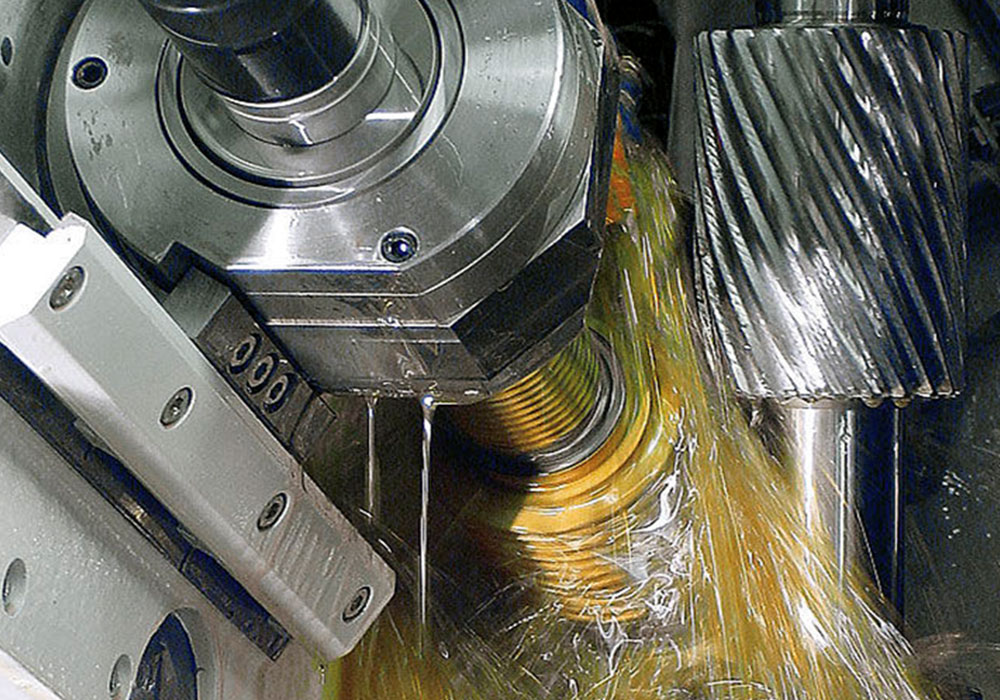
Dressing is a critical step in precise gear grinding that preserves wheel geometry and surface quality. However, excessive or deliberate dressing typically causes a hidden productivity loss by depleting important spindle time, power, and wheel material. Dressing intervals are still time-based in many Indian gear shops, beginning after a set number of parts rather than the actual state of the wheel.
Overdressing occurs when several wheel refreshes are performed, causing the parts to degrade and stop performing earlier than intended, while the quality of the parts does not increase considerably. This approach ignores dynamic elements that influence wheel dulling rates, such as grinding load, stock variation, and material hardness.
The adaptive, condition-based control system is a novel and unique approach that uses vibration signals, aural emissions, or spindle power data in real time to determine whether the wheel requires dressing. Because adaptive control runs based on process feedback rather than fixed timetables, it not only minimises waste but also preserves quality and permits machines to cut rather than sit idle.
The spark-out phase in gear grinding happens when the wheel continues to rotate against the workpiece after the feed action has stopped. This final phase stabilises geometry and creates the desired surface smoothness by removing minor flaws. Spark-out time is generally set manually, resulting in excessive wheel wear and lost machine time.
Adaptive control systems provide intelligence at this step. They can detect whether material removal has stabilised by monitoring real-time data such as spindle load, vibration, and acoustic emission (AE). When the system recognises constant signal patterns, the spark-out phase automatically terminates, indicating that there will be no more cutting.
The system does not rely on fixed time settings. Instead, it employs highly fine feedback loops that respond to grinding conditions in real time. By correctly tweaking the loop, the “sweet spot” is found, which is just enough spark-out to ensure precision and surface quality, but no more than a millisecond. The results are consistent precision, less tyre wear, and better cycle economy.
The Evident Payoff
When adaptive control systems are properly implemented at every level of operations, it transform the whole process from a fixed-time operation to a real-time optimisation process. Once cutting forces have stabilised, this system will automatically halt the spark-out phase, minimising idle grinding and unnecessary wheel wear.
Reishauer, Klingelnberg, and Indian integrators such as Micromatic Grinding Technologies have all generated real-time field data and testing that regularly show demonstrable benefits. By minimising heat load and wheel dulling, adaptive control and improved spark-out can improve surface finish (Ra), extend wheel life by 15-20%, and reduce dressing frequency by 25-40%.
Similar results have been demonstrated in Indian installations using retrofits with Siemens adaptive control modules and Marposs acoustic emission (AE) sensors, particularly in medium-volume gear finishing lines. Not only is productivity increased, but process stability, burn marks, and part-to-part repeatability are all improved. During the grinding process, the technology demonstrates that even minor process intelligence can yield substantial results and provide quantitative data.
Implementing adaptive control necessitates more than just attaching new sensors; it also means ensuring that the entire system integrates seamlessly with the existing machine logic. The initial step in the compatibility assessment process is to verify that the grinder’s control system is capable of processing real-time inputs like spindle load, vibration, and acoustic emission (AE) signals.
To fine-tune adaptive loop gains in controlled conditions, begin with small-batch trials. During manufacturing, early tuning helps to avoid overcorrection or delayed response. After adjusting the configuration, check the gains with dressing interval logs, power trace monitoring, and surface finish inspection.
Involving the operator is vital. Employees should be educated to understand system feedback and to adjust sensitivity thresholds to fit different part shapes or materials. Finally, to enable condition-based maintenance and historical data recording, consider coupling adaptive control with a grinding process monitoring or MES solution. This rigorous methodology transforms adaptive control from a feature to a reliable process capability, ensuring consistency and dependability.
Within the context of Industry 4.0, adaptive control is a natural fit, adding intelligence and connectivity to a process that would otherwise be considered conventional. It makes the grinder self-correcting, real-time instruments just by establishing a closed feedback loop that helps it to react automatically to load, vibration, or AE signals upon various set thresholds.
Power traces, dressing intervals, spark-out duration, and other operations-specific data produced during grinding can all be easily connected to MES or quality management systems. Thus, adding for better traceability, trend analysis, and process optimisation across batches and materials.
Adaptive control will play a quite useful and effective first step toward predictive process control in the Indian gear manufacturers. Without requiring a significant investment in new machinery, it transforms current grinders into intelligent, networked assets that increase accuracy, uptime, and data visibility.
Adaptive control, along with better spark-out, are two intelligent and high-value upgrades that are capable of providing measurable benefits by not asking for a huge capital expenditure at the same time. The gear makers can dress less often, and the wheels will last longer, and the quality will be maintained with the increased output, since they are responding to the actual process conditions rather than scheduled cycles.
The same adaptive intelligence seems to be the next step for India’s gear sector, which is constantly thinking about efficiency and accuracy to get into the competition. The combination of data-driven control and traditional craftsmanship makes every grinder a more intelligent and trustworthy machine. The precision through the flexibility is no longer a mere technical choice but a digital manufacturing practice in a larger trend and a very defining feature of the modern gear shop.