How advanced surface engineering is helping cutting tools withstand higher speeds, temperatures and demanding machining conditions
The cutting tool industry is undergoing a continuous shift toward higher productivity, shorter cycle times and machining of increasingly difficult materials. Higher cutting speeds, greater feed rates, dry machining and demanding workpiece materials are placing greater thermal, mechanical and tribological loads on cutting edges.
While advances in carbide, cermet, ceramic and other tool substrates have significantly improved cutting performance, the surface of the cutting tool remains one of the most critical factors determining tool life and machining efficiency.
This is where Physical Vapour Deposition (PVD) coatings play an important role.
Modern PVD coatings can provide a combination of wear resistance, hot hardness, oxidation resistance and controlled friction characteristics, helping cutting tools operate under demanding machining conditions. Research has demonstrated the performance advantages of PVD-coated tools across different machining applications and difficult-to-machine materials.
The Changing Demands on Cutting Tools
The objective of modern machining is no longer simply to remove material. Manufacturers increasingly need to achieve:
These requirements create a challenging environment at the tool–workpiece interface.
During cutting, the tool edge is exposed simultaneously to high temperatures, friction, mechanical loading, abrasion, adhesion and chemical interactions. Depending on the application, these conditions can lead to flank wear, crater wear, chipping, built-up edge formation and progressive degradation of the cutting edge.
A coating therefore cannot be viewed simply as an additional layer on a tool. It needs to function as an engineered surface that interacts with the substrate, workpiece material, cutting parameters and machining environment.
How PVD Coatings Improve Cutting Tool Performance
PVD is a vacuum-based coating technology capable of depositing thin, hard protective films onto cutting tools.
The coating acts as a functional interface between the tool substrate and the machining environment. Depending on its composition and architecture, it can provide several performance advantages.
1. Improved Wear Resistance
A major function of a cutting-tool coating is to delay abrasive and adhesive wear.
During machining, continuous contact between the tool and workpiece can progressively damage the cutting edge. Hard PVD coatings can provide a protective surface capable of resisting these wear mechanisms.
Studies comparing coated cutting tools have demonstrated the importance of coating composition in determining wear behaviour and tool life. In particular, TiAlN and AlCrN-based coatings have demonstrated strong performance under demanding cutting conditions.
2. Thermal Stability for High-Speed Machining
As cutting speeds increase, the temperature generated near the cutting edge becomes increasingly important.
Coatings with high hot hardness and oxidation resistance can help maintain the functional properties of the cutting edge at elevated temperatures. This becomes particularly relevant in high-speed cutting and dry machining, where the thermal load on the tool can be substantial.
The development of Al-containing nitride coatings, for example, has been closely associated with the requirements of high-performance cutting applications and improved resistance to elevated-temperature conditions.
3. Reduced Friction
Friction between the cutting tool and workpiece or chip contributes to heat generation and can accelerate tool degradation.
Appropriately engineered coatings can reduce friction and minimise the tendency of workpiece material to adhere to the tool surface. This is particularly valuable when machining materials such as aluminium alloys, titanium alloys and high-alloy steels, where adhesion and thermal loading can significantly influence tool performance.
Research on PVD-coated tools has shown that coating selection can influence work-material adhesion and wear behaviour at the tool–chip interface.
4. Enabling Difficult-to-Cut Materials
Modern industries such as aerospace, automotive, medical and energy increasingly use materials that present significant machining challenges.
Titanium alloys, nickel-based alloys, hardened steels and high-alloy materials can generate substantial heat and mechanical loading during machining.
For such applications, the coating has to be selected according to the specific combination of tool substrate, workpiece material, cutting speed, feed, depth of cut and machining environment. Research on Cronova- check to include coated carbide tools, for example- has investigated their effectiveness in machining titanium alloys under high-temperature cutting conditions.
Coating Selection Is Application-Specific
One of the most important developments in modern PVD coating technology is the move away from a “one coating fits all” approach.
A coating that performs exceptionally well in one machining application may not necessarily provide the same results in another.
The appropriate coating architecture and chemistry depend on factors such as:
Workpiece material → Tool substrate → Cutting parameters → Machining operation → Thermal load → Wear mechanism → Required tool life
For example, the requirements for a high-speed milling application can be very different from those of drilling, threading or gear cutting.
This makes coating selection an engineering decision rather than simply a purchasing decision.
PVD Coatings Across Cutting Tool Applications
The versatility of PVD technology allows coatings to be developed for a broad range of cutting applications.
These include:
This broad application range makes advanced PVD coatings an important part of the modern cutting-tool ecosystem.
Unitherm Nova Coating: Engineering the Surface for the Application
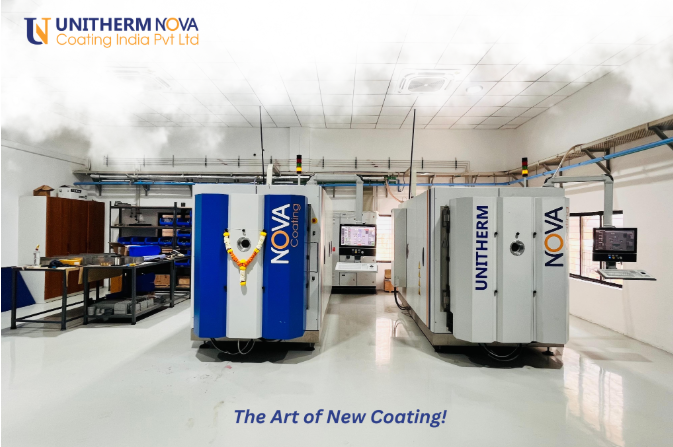
Unitherm Nova Coating (UNC) brings advanced PVD coating technology to the cutting-tool industry with a focus on performance-oriented surface engineering.
UNC’s cutting-tool coating solutions are designed to address the requirements of demanding machining operations, with emphasis on wear protection, thermal stability, hot hardness, oxidation resistance and controlled friction. The solutions are applicable across turning, milling, drilling, reaming, threading and gear-cutting applications.
A key aspect of this approach is the ability to develop coating solutions around the application rather than treating the coating as an isolated component.
For cutting-tool manufacturers and reconditioning specialists, this means considering the complete machining system — from substrate and tool geometry to workpiece material and cutting parameters.
From Tool Coating to Process Performance
The real value of a PVD coating should ultimately be measured by its impact on the machining process.
A high-performance coating can contribute to:
Longer tool life
↓
Fewer tool changes
↓
Lower machine downtime
↓
More consistent machining
↓
Higher productivity
However, achieving these benefits requires more than simply applying a hard coating. Surface preparation, substrate condition, coating adhesion, coating architecture and process control are all critical to achieving consistent performance.
For this reason, the future of cutting-tool coatings lies in application-specific engineering — matching the coating technology to the actual demands imposed on the tool.
Looking Ahead
The cutting-tool industry will continue to move toward higher cutting speeds, increased automation, dry and minimum-quantity lubrication machining, and the processing of advanced materials.
As these demands increase, surface engineering will become even more important.
The next generation of PVD coatings will not be defined solely by hardness. Thermal behaviour, toughness, oxidation resistance, friction, adhesion, coating architecture and compatibility with the tool substrate will increasingly determine coating performance.
For cutting-tool manufacturers, the objective is therefore not simply to make the surface harder. It is to engineer a surface that performs reliably under the specific conditions in which the tool operates.
Unitherm Nova Coating (UNC) is a joint venture between Unitherm Engineers and Nova Coating GmbH, Germany, specialising in advanced PVD coating solutions. Its coating technologies serve applications including cutting tools, dies and moulds, & components with solutions engineered to enhance wear resistance, tool life and process performance.
Looking to improve cutting-tool life, machining consistency or productivity? Talk to the Unitherm Nova Coating team to evaluate the right PVD coating for your tool substrate, workpiece material and machining conditions.
Ajit Patil,
CEO, Unitherm Nova Coating
About the Author
Ajit Patil is the Chief Executive Officer of *Unitherm Nova Coating (UNC)*, a joint venture bringing together Unitherm Engineers’ expertise in India with Nova Coating’s advanced German surface-coating technology. With extensive leadership experience and a strategic business approach, Ajit focuses on driving customer value, business growth and operational excellence. At UNC, he is leading the company’s growth in advanced PVD coating solutions for demanding industrial applications, with a strong emphasis on technology, quality and long-term customer partnerships.
Contact: Unitherm Nova Coating | info@unc-india.com
Website: www.unc-india.com
LinkedIn: https://www.linkedin.com/company/unitherm-nova-coating