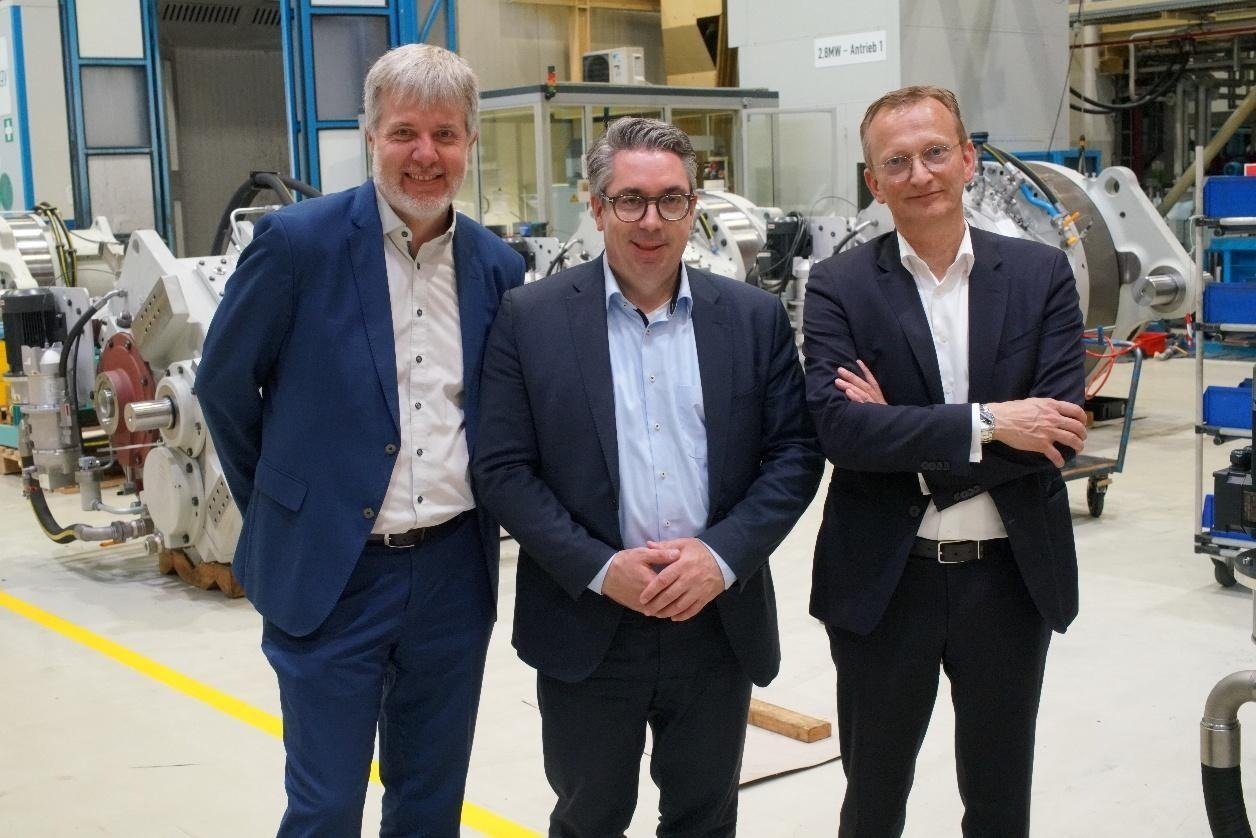
Flender in dialogue with State Secretary Stefan Rouenhoff
Flender welcomed Stefan Rouenhoff, Parliamentary State Secretary to the Federal Minister for Economic Affairs and Energy, to its site in Voerde. The visit focused on the innovative strength of the German wind energy industry and the importance of industrial collaborative research (IGF) for the German economy.
Flender CEO Andreas Evertz gave State Secretary Rouenhoff a tour of the gearbox assembly area and presented the new REVO drive concept, which sets a new standard in wind energy with a torque density of 300 Nm/kg. The visit underscores the role of companies like Flender as drivers of innovation in the energy transition—and the need for reliable research funding for the industry.
A central focus of the visit was the presentation of the new REVO drive concept. It is the first gearbox concept to reach the threshold of 300 Newton-meters per kilogram (Nm/kg) of torque density—a quantum leap for the industry. For the same output, the outer diameter of the gearbox can be reduced by up to 25 percent. The result: more compact, lighter nacelles, lower material, transport, and installation costs, as well as the development of new sites that were previously logistically inaccessible.
Compared to gearboxes of the same power class from 2010, REVO enables a
reduction in CO₂ emissions of around 70 percent. In addition, road transportability is maintained for current and future turbine classes exceeding 8 megawatts.
“With REVO, we are demonstrating that groundbreaking innovations for the energy transition are emerging here in Germany,” said Andreas Evertz, CEO of the Flender Group. “One in three wind turbines worldwide runs on Winergy drive technology. At our site in Voerde, around 1,300 people are working to make wind energy increasingly efficient and cost-effective. The industry creates thousands of highly skilled jobs and is a growth engine for Germany as an industrial location.”
“Flender GmbH has strengthened its position in the wind energy sector in recent years through innovation, the expansion of its service business, and investments in international markets. Today, the company ranks among the global market leaders in the field of wind power drivetrains. This is a great success. The employees at the Voerde site in the Lower Rhine region, in particular, but also the industrial collaborative research program of the Federal Ministry of Economics, have made an important contribution to this,” explained State Secretary Rouenhoff during his tour of the company.
Industrial Collaborative Research (IGF), the Federal Ministry of Economics’ central funding program for pre-competitive research, is also regarded by Flender as a key instrument for research funding. In the IGF, companies of all sizes join together in non-profit research associations to define the research needs of their industry. One hundred percent of the public funding goes directly to research—at universities and research institutions—and precisely addresses the needs of industry. The transfer of knowledge into industrial practice occurs quickly, without discrimination, and with broad impact.
Within the framework of IGF projects, Flender works closely with universities and research institutions on fundamental topics such as innovative hardening processes for gear teeth, the further development of plain bearing technology, and the development of new generators with significantly reduced use of rare earth elements. The insights gained from this research flow directly into product innovations such as REVO —a prime example of how IGF-funded basic research leads to market-ready innovations.
In mechanical engineering alone, over 800 companies with approximately 4,500 experts are active in the VDMA’s research associations. Unfortunately, however, about 30 percent of the projects initiated by industry and positively evaluated cannot be implemented due to a lack of government funding—resulting in the loss of existing innovation potential. The VDMA estimates that the necessary increase in funding must rise from the current level of around 180 million euros to 300 million euros.
“The Voerde site is an excellent example of how successful joint industrial research can be,” emphasized Evertz. “Technologies developed in collaboration with universities as part of IGF projects are now incorporated into REVO—our most powerful drive concept. This program is a unique tool for small and medium-sized industrial companies: Research funds flow into science, the results benefit the entire industry, and at the end of a project, young engineers are ready to transition into industry—an effective remedy for the shortage of skilled workers. We strongly urge the federal government not to cut the IGF further, but to significantly strengthen it.
Industry must be given the priority it deserves in research funding.”
State Secretary Stefan Rouenhoff explained that, given the tight budgetary situation, significant savings would be necessary in the upcoming federal budget. Due to the early stage of the budget discussions, Rouenhoff could not say whether or to what extent the IGF would be affected by this.
Following the discussions, State Secretary Rouenhoff toured the gearbox assembly facility at the Voerde site, where approximately 1,300 employees work. There, he gained an impression of the state-of-the-art production facilities, the impressive vertical integration, and the quality standards that distinguish Flender as a global market leader in the field of wind energy drive technology. The REVO prototype was on display on-site for comparison with conventional drive systems—the compactness of the new concept is immediately apparent.
In addition to the wind business, Flender also presented the State Secretary with its broad portfolio of industrial drives and couplings for key industries such as c , cement, raw materials processing, marine, and power generation. The company thus underscores its role as a comprehensive drive technology specialist with global reach and strong roots in Germany.
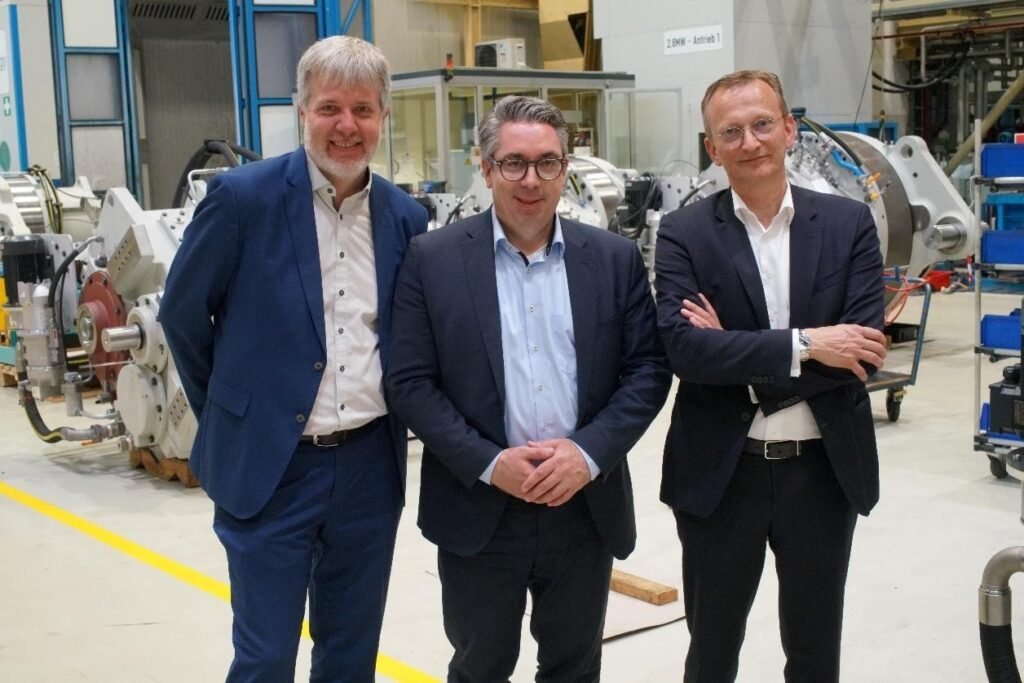
Flender CEO Andreas Evertz (right) and Dieter Janecek, Global Head of Public Affairs at Flender, gave State Secretary Stefan Rouenhoff (center) a tour of the gearbox assembly facility at the Voerde site.
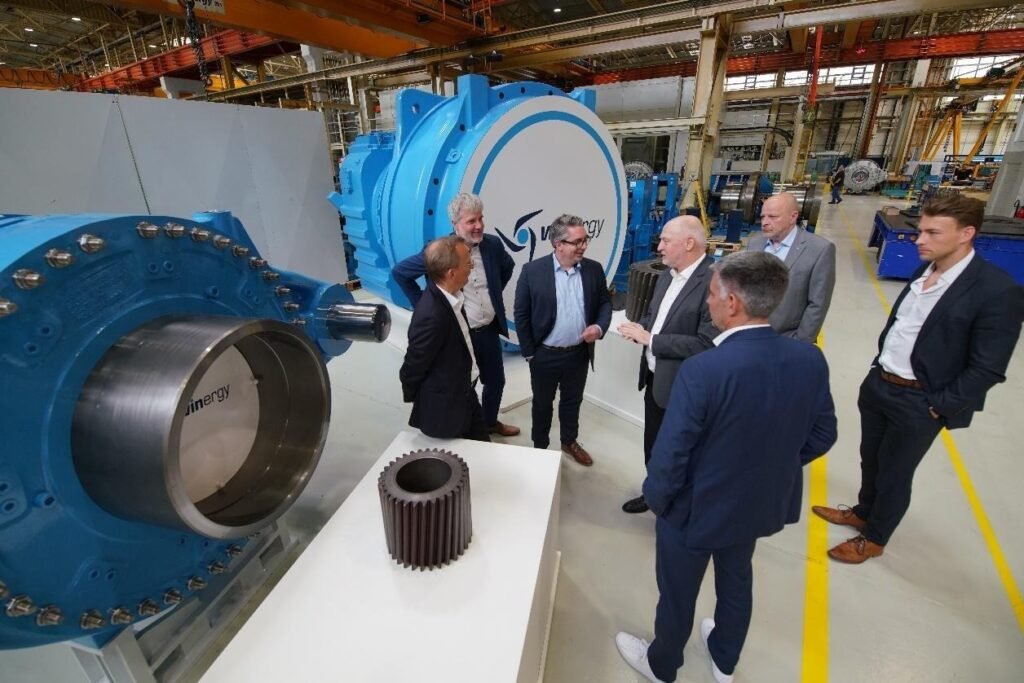
The exhibit showcasing the REVO drive concept (left in the picture) made the new dimension in power density and compactness visible and tangible.
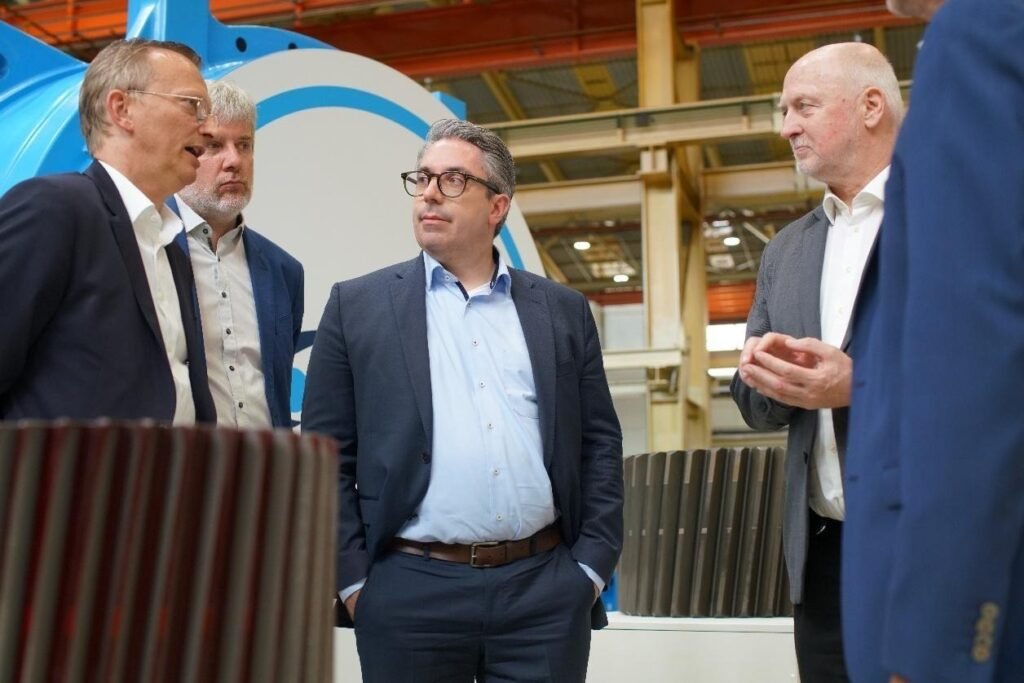
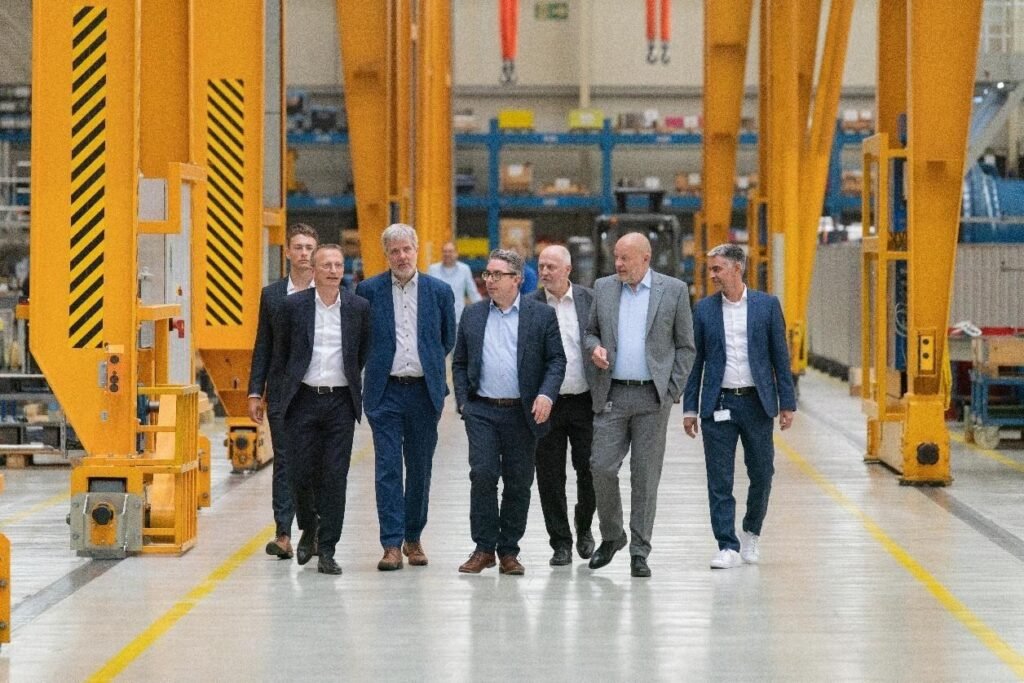
State Secretary Rouenhoff was impressed during his tour of the Flender assembly halls: “Flender is now one of the global market leaders in the field of wind power drivetrains. That is a great success.”
Flender is a leading, tech-enabled provider for drivetrain solutions, globally supplying highest quality, performance, and innovation for more than 125 years. Flender offers a wide range of gear units, couplings, generators, and associated digitally enabled lifecycle services across various end markets. The two product brands “Flender” and “Winergy” focus on key industries such as wind energy, minerals and mining, cement, power generation, plastic and rubber, marine and metals. With efficient drivetrain solutions and a strong CSR focus, Flender is the partner of choice for a sustainable future. The renowned sustainability rating by EcoVadis ranks Flender among the top 1 percent of the most sustainable companies worldwide. Flender employs more than 8,000 people globally. The company is headquartered in Bocholt, Germany. For more information, visit www.flender.com.