In the world of gear manufacturing, precision has traditionally been associated with geometry, surface finish, hardness profile, and metallurgical integrity. However, an increasingly decisive parameter is reshaping quality expectations across automotive and industrial transmission sectors — technical cleanliness. As gear systems evolve toward tighter tolerances, higher operating speeds, and electrified powertrains, microscopic contamination introduced during manufacturing, heat treatment, washing, handling, or assembly can become functionally significant.
Today, technical cleanliness is not merely a compliance requirement. It is increasingly becoming a competitive differentiator.
Why Technical Cleanliness Matters in Gear Technology
Gears operate under high contact stresses and precise lubrication regimes. Under critical operating conditions, hard metallic particles trapped between mating surfaces may accelerate wear, induce localised surface damage, or contribute to micro-pitting mechanisms. In high-performance transmissions and e-drive systems, contamination may additionally affect bearings, lubrication channels, seals, and magnetic systems.
The shift toward electric mobility has amplified this concern. EV drivetrain systems often operate at higher rotational speeds and lower background noise levels, making them more sensitive to contamination-related wear, bearing performance, and NVH concerns. Unlike internal combustion systems, where engine noise can mask mechanical irregularities, EV drivetrains expose even subtle gear defects. Consequently, contamination that may have once been tolerated can now become functionally significant.
For gear manufacturers, technical cleanliness directly impacts:
Increasingly, OEMs and Tier-1 suppliers specify contamination limits not only for assembled transmission systems but also for individual components such as gears, shafts, synchronizers, housings, and bearings.
In gear manufacturing, technical cleanliness assessment is increasingly applied after hobbing, shaving, grinding, superfinishing, washing, and assembly preparation stages. Components such as transmission gears, differential gears, shafts, synchro parts, bearing interfaces, and gearbox housings are often monitored to reduce contamination-related performance risks.
Understanding Technical Cleanliness Requirements
Technical cleanliness refers to the measurement and control of particulate contamination present on a component surface. The objective is to characterise and control particulate contamination so that cleanliness levels remain within customer-defined or functionally acceptable limits.
Most automotive and industrial gear manufacturers follow internationally accepted methodologies such as:
Although these standards originated in automotive applications, their adoption has expanded rapidly across industrial gearboxes, aerospace components, precision engineering, hydraulics, and energy systems.
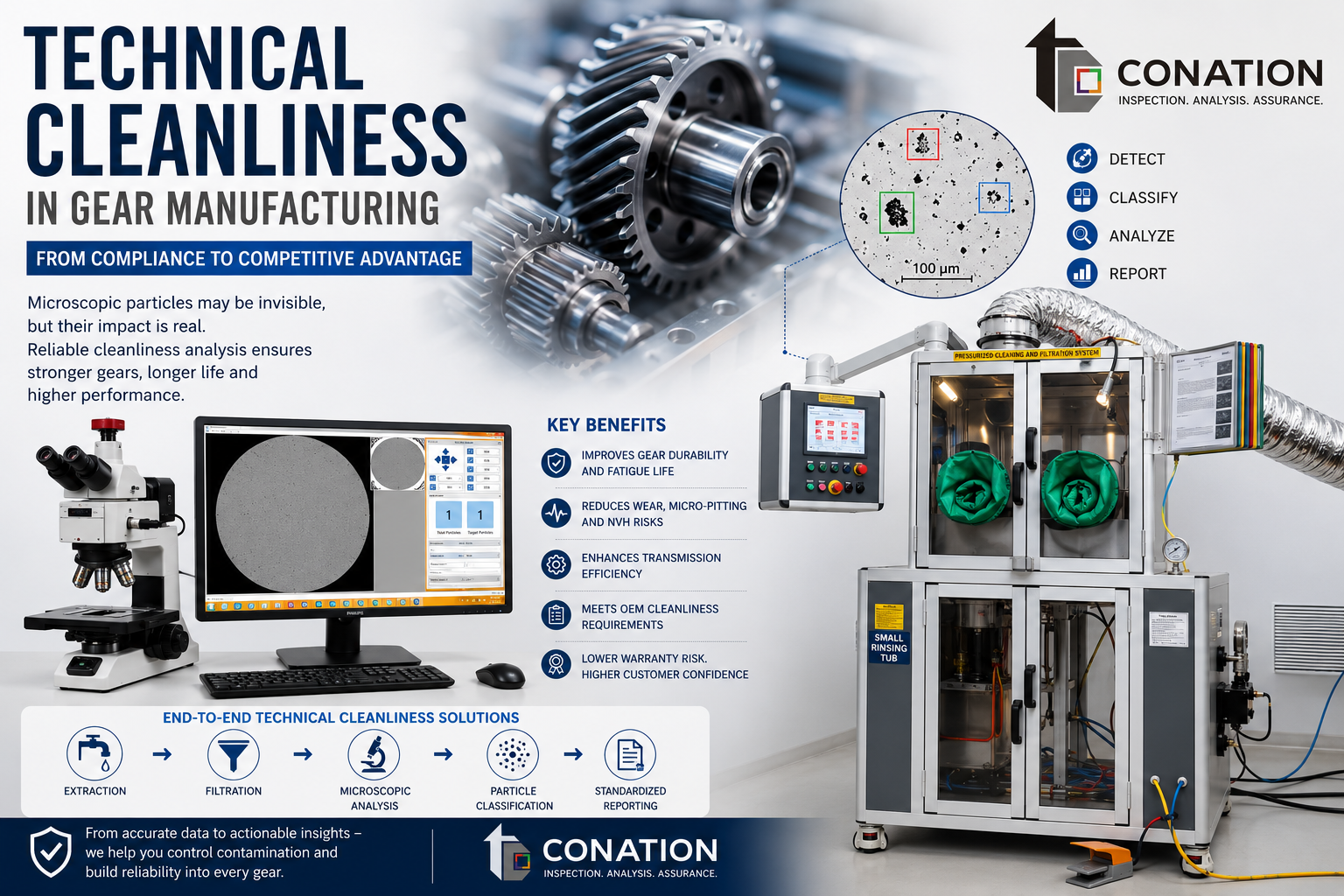
A typical technical cleanliness workflow includes:
However, achieving reliable results is more complex than simply counting particles. Repeatability, contamination control during testing, extraction efficiency, and image analysis accuracy play equally important roles.
The Hidden Challenge: Measuring What Truly Matters
One of the major industry challenges is distinguishing between harmless contamination and functionally critical particles.
For example, a small soft fiber may be less harmful than a large hard metallic particle generated during grinding or machining. Similarly, contamination originating from shot blasting, honing, heat treatment scales, abrasive wear, or washing media must be interpreted differently depending on application risk.
In gear manufacturing, particular attention is often given to:
Modern technical cleanliness assessment, therefore, goes beyond particle counting. It increasingly focuses on particle characterisation, enabling engineers to identify root causes and improve manufacturing processes.
Instead of asking “How many particles are present?”, quality teams are now asking “Where are these particles coming from, and what functional risk do they represent?”
This shift is driving new technological advancements in contamination analysis.
Advancements Reshaping Technical Cleanliness
1. Automated Microscopy and Intelligent Image Analysis
Traditional manual particle inspection was time-consuming and operator-dependent. Today, automated optical microscopy combined with intelligent image analysis has significantly improved consistency and throughput.
Modern systems can automatically detect, segment, classify, and measure particles based on morphology, brightness, aspect ratio, and reflectivity characteristics, improving repeatability and enabling practical differentiation of likely metallic and non-metallic contaminants.
2. High-Resolution Particle Characterisation
As gear systems become more precision-driven, the ability to analyse finer particles has become increasingly important.
Advances in optics, illumination, and digital imaging now enable reliable detection and characterisation of increasingly finer particulate contamination within practical inspection limits. Higher-resolution imaging helps improve identification of elongated metallic chips, sharp-edged contaminants, and wear-inducing particles — particularly valuable in EV drivetrain applications where contamination can influence acoustic behaviour and bearing performance.
3. Data-Driven Process Improvement
Technical cleanliness is gradually evolving from a quality inspection tool into a process optimisation instrument.
Instead of only generating pass/fail reports, manufacturers are using contamination data to:
Trend analysis helps identify recurring contamination sources before they become field failures. In many advanced manufacturing environments, cleanliness data is increasingly integrated into broader digital quality systems.
Addressing Industry Needs: The Conation Approach
At Conation Technologies Pvt. Ltd., we have observed a clear shift in customer expectations. Manufacturers no longer seek only compliance-oriented inspection systems; they require reliable and repeatable technical cleanliness ecosystems capable of delivering trustworthy results.
One of the overlooked realities in technical cleanliness is that measurement accuracy begins long before microscopy. Even advanced particle analysis systems can produce inconsistent results if contamination is introduced during extraction, filtration, membrane handling, or sample preparation.
To address this challenge, Conation provides end-to-end technical cleanliness solutions covering extraction, filtration, microscopic evaluation, image analysis, and standardised reporting workflows.
A key strength is its specialised Contamination Test Cabinets (CTC), designed to minimise environmental contamination during critical preparation stages and improve repeatability in cleanliness testing aligned with ISO 16232 and VDA methodologies.
In addition, Conation solutions for Particle Analysis support automated particle detection, morphology-based analysis, reflective/non-reflective differentiation, and contamination source interpretation to help manufacturers correlate contamination with processes such as hobbing, grinding, heat treatment, washing, deburring, and assembly.
Our experience suggests that technical cleanliness delivers maximum value when treated as a manufacturing intelligence tool rather than a compliance activity. The goal is not simply to count particles, but to understand their origin, control their generation, and continuously improve process capability.
The Road Ahead
The future of gear technology will increasingly depend on invisible parameters. As powertrains become more efficient and electrified, acceptable contamination thresholds are expected to tighten further. Technical cleanliness will increasingly move from a supplier audit requirement to an integrated process engineering discipline, supported by automation, intelligent image analysis, and digitally connected quality systems.
For gear manufacturers, the challenge is no longer simply achieving dimensional precision — it is ensuring that microscopic contamination does not compromise macroscopic reliability.

Prashant Pachave
Head–Applications, Conation Technologies Pvt. Ltd., Pune