By Shivin Gupta, CEO, Maxwell Tools Company
In gear manufacturing, finishing accuracy, service life, and noise behaviour are often discussed at the gear level, but the truth is that many of those characteristics are shaped much earlier — at the cutting tool.
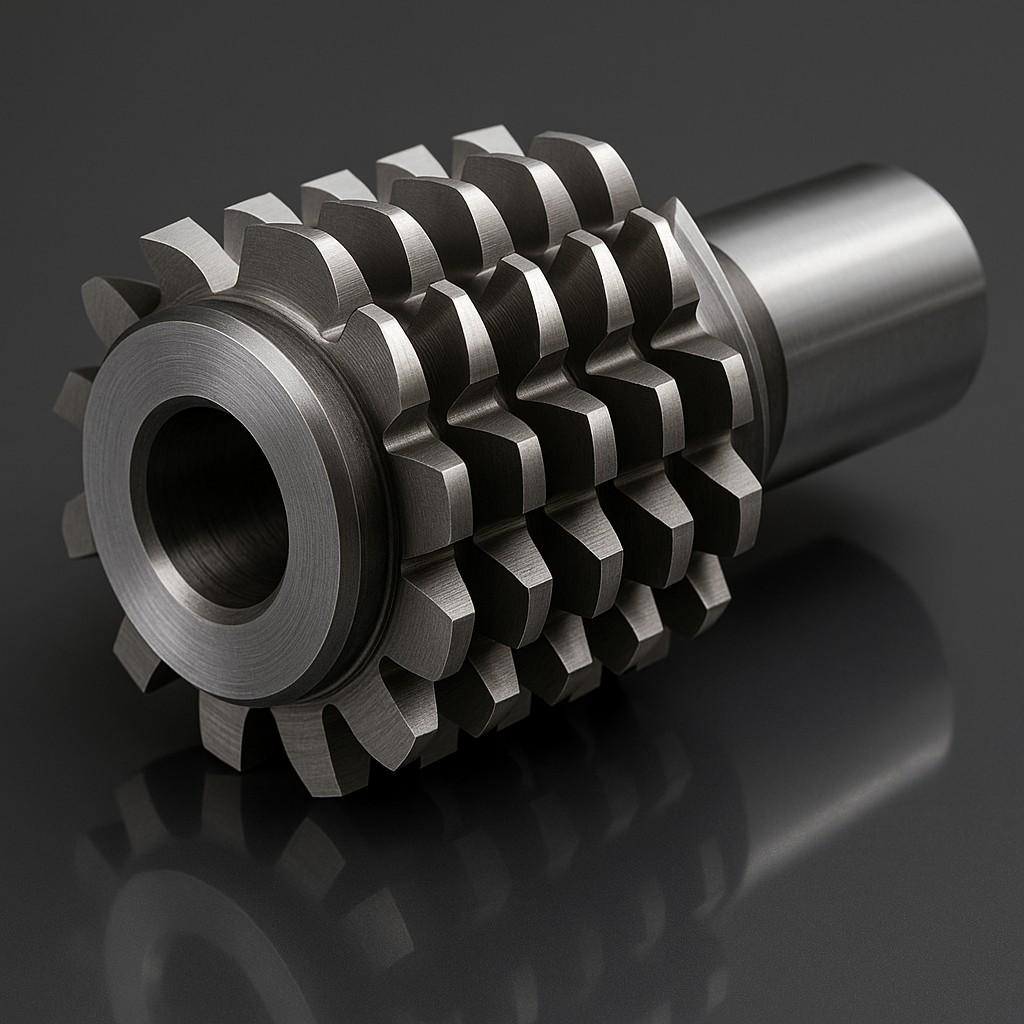
A gear hob or a gear milling cutter is the first point where the intended tooth profile physically becomes metal. If the cutting tool doesn’t do its job consistently, no amount of finishing or inspection afterwards can recover the original fidelity of the profile.
This article is simply a set of observations gathered from real plants, real production lines, and the real challenges people face when cutting gears.
The performance of a gear-cutting tool depends on three core elements:
If even one of these is misaligned with the application, the tool may cut — but it won’t sustain. The breakdown usually does not look dramatic; it shows up slowly in:
These are the failures that cost the most — because they spread across batches.
Traditionally, M2 high-speed steel has been the standard for gear cutting tools. It is tough, forgiving, and well-understood. However, as cutting speeds increased and gear steels hardened further, M2 started showing limitations in:
The natural evolution was M35, which incorporates cobalt. In practice, the difference becomes noticeable when:
M35 tends to retain cutting-edge sharpness longer under these conditions.
But the most significant shift came with powder metallurgy steels like ASP23 and ASP30.
The key benefit of these steels is not just “higher hardness.”
It is uniformity — the distribution of carbides is more consistent, which makes the cutting edge much more stable over time.
This results in:
In shops cutting gears for defence, aerospace, or tight-tolerance industrial gearboxes, this consistency is often more valuable than maximum theoretical hardness.
Two tools made from the same grade of steel, machined on the same grinder, can behave completely differently depending on how they were heat-treated.
A few patterns tend to repeat in real-world production:
A poorly heat-treated cutting tool often performs perfectly for the first few hundred pieces — and then fails abruptly.
“It was cutting beautifully… until it wasn’t.”
The most stable results I have observed typically come from:
This approach reduces retained stresses and results in predictable wear progression, which is far more important than peak hardness value on paper.
When discussing tools, most people talk first about steel and hardness. However, in practical performance, geometry is just as influential, especially in:
A well-designed flute or gash pattern often reduces cutting temperature by simply letting the chip leave the cutting zone properly.
A stable cutting process is not created by coating or steel alone — it is created by enabling the chip to get out of the way.
Another overlooked factor is edge preparation. A perfectly sharp edge is not always ideal.
A controlled micro-honed edge lasts longer and behaves more predictably. This is learned through experience — not calculation.
Even if the module and tooth profile are the same, the application conditions can make two tools behave differently.
| Application | What the Tool Experiences | What the Tool Needs |
| Automotive Transmissions | High cycle count + NVH sensitivity | Stable lead accuracy + low edge breakdown |
| Tractor & Agriculture Gearboxes | Shock loads + contamination | Higher toughness + controlled wear progression |
| Industrial Gearboxes | Long life under continuous load | Strong finish consistency + geometry stability |
| Defense/Aerospace | Zero tolerance for variability | Predictable wear pattern + repeatable regrinds |
Because of this, tool performance improves substantially when:
The improvements rarely come from changing just one factor.
In many production environments, cost-saving efforts focus on:
However, I have repeatedly seen the largest savings come from:
If a tool needs one fewer regrind per batch, or if operators stop compensating feed rates mid-run, the cost-per-gear drops significantly, quietly and continuously.
This does not show up on a quotation sheet.
It shows up in the stability of the production floor.
Gear manufacturing has seen improvements in speed, noise reduction, and precision, but certain fundamentals remain unchanged. The accuracy of a gear is directly linked to the precision of the tool that cuts it. More important than the maximum specification of the tool is its consistency during use. Both heat treatment and the geometry of the tool play a crucial role in the final outcome, influencing performance as much as the steel grade used in the tool. Essentially, a gear cutting tool serves as the foundation of the gear’s life, underscoring the critical importance of high-quality, reliable tooling in achieving precise, durable gear products. High-quality gear cutting tools—such as gear hobs and milling cutters—are essential for producing accurate gear teeth and ensuring the overall quality and longevity of the gears. Advanced materials and coatings in these tools enhance cutting speeds, tool life, and consistent performance, which translates to improved productivity and reduced operational costs in gear manufacturing processes