For manufacturers of wind turbines, Zahnradfertigung Ott GmbH & Co. KG is a highly requested supplier. The production of ring gears with diameters of 2500 mm and especially internal gears requires a high level of expertise, qualified employees and the right machines, such as the ZP I/E profile grinding machine from Kapp Niles. The solid construction and the large grinding head – the more is here the better – ensure maximum precision.
Zahnradfertigung Ott GmbH & Co. KG is based in Bodelshausen, in the district of Tübingen. Founded in 1957, the family-owned company now has 156 employees and about 10,000 m2 floorspace. The production range includes a wide variety of gears and gearboxes for industry, transport, logistics, oil and gas extraction, etc.
Wind power: large gears, high demands
Wind power increasingly characterises the portfolio of the company, which has established itself as one of the first suppliers for this industry in Europe. Already in 1999, Ott converted a machine for the manufacture of helical ring gears for this purpose. It was clear that the quality requirements for wind turbine gearboxes could only be achieved with ground gears. The customer requirements according to DIN ISO 1328-1 are usually quality 7 or 6, sometimes even 5, as Siegfried Nill, Production Manager at Ott, confirms: ‘The desired surface quality, pitch and profile accuracy can only be achieved by grinding. In addition, corrections are made to the tooth profile and the flank line, such as tip and root relief, end relief and a defined crowning or taper.’ This enables optimising power transmission within the gearbox and thus improves running smoothness, as Nill explains: ‘Today, it is possible to simulate deformations and displacements of components under load. In the past, this could only be estimated theoretically, but today the designers know in advance how a tooth will deform under load, and it can be compensated for in advance. In this way, the contact ratio of the gear under load can be maximised.’ The pinions or ring gears are, to exaggerate a little, ground conical so that they straighten under load. Machines for grinding internal gears up to 2,500 mm in diameter have therefore long been part of the production portfolio. Nill again: ‘Wind turbines are becoming increasingly larger and more powerful. This results in ever larger gearboxes and thus tooth widths. Year after year, gearbox manufacturers have planned larger types and asked us whether we can do this. Of course, we agreed, bought the appropriate machines or even had them converted to fit. That’s how we grew into the wind business, especially in the area of ring gear production, in other words, internal gears for large parts.’
Precise, robust and flexible – grinding machines from Kapp Niles
Kapp Niles was not part of Ott’s machine park for a long time. This only changed in 2018, when an old grinding machine needed to be replaced. Ott became aware of a used Kapp Niles ZP I/E machine through a machine dealer. These gear profile grinding machines are used for high-precision grinding of large-module internal gears. A special feature is the grinding head: It can be rotated by 180° so that the machine can be converted for grinding external gears and special profiles in a very short time (Image 1). The largest version of the series enables the machining of internal gears with a root circle diameter of up to 2,900 mm. The used machine was designed for 2,500 mm. Jens Haag (Image 2), member of the board, remembers it well: ‘The machine was interesting in terms of price and only had a short running time. Although it was second-hand, its quality was impressive. That’s why we bought a second, new machine a few years later, which complements our production very well.’
Markus Reißenweber, Sales Manager America and Europe at Kapp Niles, describes the highlights of the machine: ‘With the solid grinding head, we achieve a high level of thermal stability. At the same time, the rigid construction prevents the grinding wheel from being displaced during grinding. Another competitive advantage is the low effort required for tool changes. The grinding wheel is mounted on one side so that the grinding head does not have to be dismantled, and the grinding wheel can be changed in just a few simple steps.’ (Image 3)
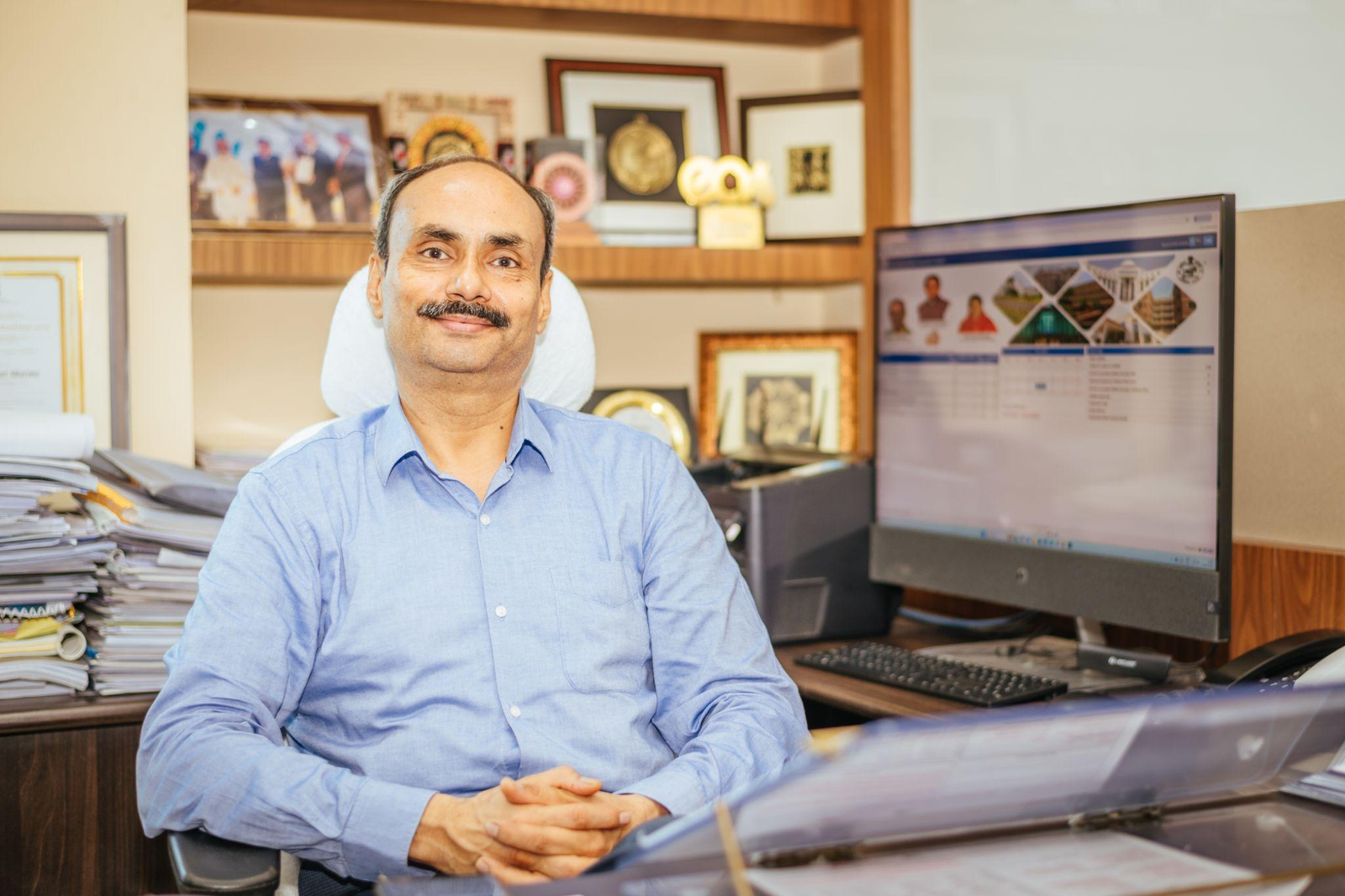
The quality of the machine is also shown in the achievable surface roughness, as Roland Löffler, the responsible department manager at Ott, reports (Image 4): ‘The majority of orders require a Ra value of less than 0.8 µm. We already achieve values between 0.4 and 0.6 µm as a standard. We also try to grind Ra values of 0.2 µm as a test, as the trend in the wind energy sector is clearly moving towards higher surface requirements, which means Ra below 0.4 µm. We have to be prepared for this, even as a contract gear manufacturer.’ The reason for this trend is the increasing output of wind turbines and, therefore, the need to maximise the efficiency of the turbine. The integrated measuring system for gear measurement is also helpful during production. Haag explains: ‘We measure during production in order to maintain our quality. Once the system is set up and the external influences are appropriate, you can rely on the results.’
A machine that stands on its own feet – cost factor foundation
Normally, machines of this size require a foundation that goes down to the ground. Required can be three or even six metres down. A special basement must then be created in the excavation pit to which the machine is bolted. Not like this with the ZP I/E. The floor simply has to bear the weight, which a modern heavy-duty floor can often do already. The shop floor at Ott dates back to the seventies and therefore had to be reinforced (Image 5). Despite this, the base was far more cost-effective than the foundation required by other manufacturers. Haag comments: ‘This also played a major role in my decision. The foundation can easily cost €200,000 for such large machines. That is not to be neglected.’
Nill adds: ‘During a site meeting about the assembly times, Kapp Niles stated three or four weeks. I thought that was impossible. But if you know that you don’t have to screw the structure to the ground, then it works. At that time, I realised how stable the machine is.’
Another benefit is the flow guide for the grinding media. Some manufacturers require a chute under the machine to collect the coolant, etc., as it drains away. With Kapp Niles, all units are on the same level as the machine.
Flexibility: A cardinal value for contract gear manufacturers
‘Flexibility is very important for us as a contract gear manufacturer. In high-volume production, there is sometimes a separate machine for each workpiece. We grind internal gears in the morning, external gears at lunchtime, and a shaft the next day. It makes a difference whether the head change overtakes five or just two hours,’ says Haag, describing his day-to-day work (Image 6). He is referring to the change of the grinding head from internal to external gearing. In addition to the quick tool change, this is another highlight of the grinding machine. The connectors for hydraulics and electrics can remain on the head during the changeover. Disconnecting and reconnecting them not only takes time. It can also easily lead to contamination, contact faults or leaks. Haag again: ‘It takes just two hours from the start of the head change to the start of the new workpiece. That’s an important point for us.’
The ZP I/E in practice
The decision to use Kapp Niles proved to be the right one for Ott Zahnradfertigung in every aspect. ‘There have been no quality issues with our standard gears, but there are more and more customised products where our machines were reaching their limits,’ says Nill, describing the initial situation (Image 7). One criterion for the new grinding machine was therefore that we could accurately reproduce the flank line, especially the area where the grinding wheel goes into the workpiece. With Kapp Niles, you notice that the tools are hardly forced out of the centre. The construction is impressive all along the line.’ Haag confirms this: ‘We have always had problems with the flank lines. We have already got the issue under control with the used machine, even when we grind modifications.’ Löffler is also impressed by the quality: ‘With some other machines, we had deviations where the grinding wheel is entering or leaving the gear, a kind of nose. We were able to solve the problem. At a face width of 600 mm, you can apply a ruler and see no deviation. That impressed us.’
The service fits as well
The Ott Zahnradfertigung team already felt well advised in advance (Image 8), recalls Nill: ‘We felt that we were taken care of when we made contact and visited the factory. All the important people were at the table. There were solid answers, and promises were kept.’ Löffler can also confirm this: ‘When we came to Berlin with our requirements, Kapp Niles had already dealt with them and had answers ready. That was very convincing. This also applies to the after-sales service. The machines run reliably, but if there is ever a problem, we can rely on a technician coming the next day.’
Haag is also convinced: ‘We are known in the market for our quality and for the fact that we maintain this consistently, not just for one particular article, but always. This requires expertise, qualified employees and the right machines. When it comes to Kapp Niles, you could say that everything is a little simpler, from the foundation to changing the head. And yet the quality is just right. That’s a great combination.’