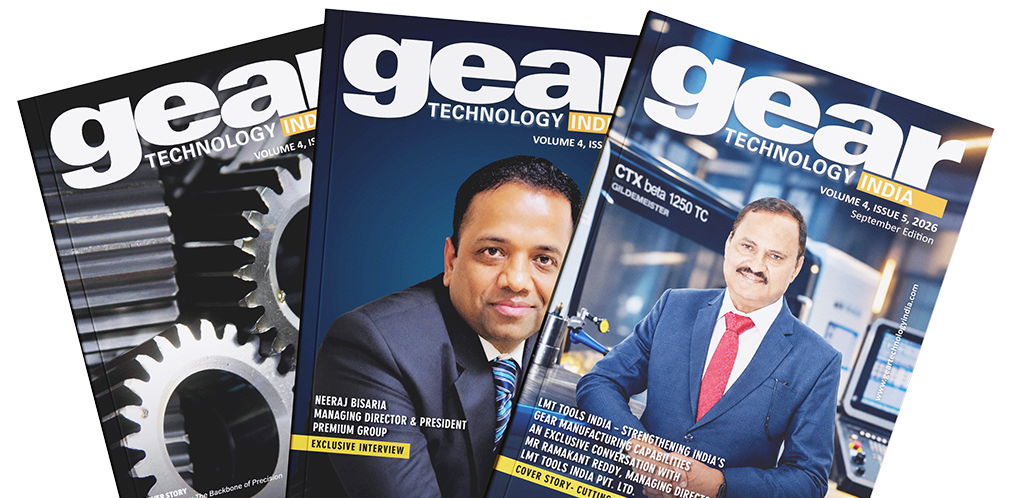
As industrial and automotive systems undergo rapid transformation driven by electrification, sustainability imperatives, and advanced manufacturing technologies, lubricants are increasingly becoming strategic performance enablers rather than mere consumables. In this exclusive interview, Sushmita Das, the Editor of Gear Technology India, speaks with Mr Satyendra Debdas, Director, APAR Industries, to understand how high-performance lubricants are supporting modern industrial systems across the globe. He shares APAR’s long-term vision for its lubricants business, insights into emerging technology and regulatory trends, and the company’s approach to sustainability, OEM collaboration, digitalisation, and global market expansion, offering a comprehensive perspective on how lubrication solutions are evolving to meet the demands of a future-ready industry.
APAR Industries defines its long-term vision for the lubricants business as becoming a global leader in sustainable, innovative, and high-performance lubricants that support the energy transition, enhance environmental sustainability, and drive value for stakeholders in a rapidly evolving market characterised by electrification, digitalisation, and stricter ESG standards.
This vision emphasises pioneering eco-friendly solutions, such as bio-based and environmentally acceptable lubricants (EALs) that are biodegradable, low-toxicity, and designed for applications like transformer oils, metalworking fluids, and engine oils, while maintaining superior performance to extend equipment life and reduce operational costs.
Key pillars of this vision include:
APAR’s lubricant formulation and R&D priorities are shaped by several key technology trends in the rapidly evolving global lubricants industry, focusing on sustainability, performance optimisation, and adaptation to emerging applications like electric vehicles (EVs). With the adoption of Electric Vehicles in India, the gear and transmission industry is definitely going to be revolutionised by the OEM offering various transmission options to the buyer. With the industry growing at a rapid pace by introducing Industry 4 standards with automation at work place, it becomes more stringent for the Lubricant suppliers to remain in the competition. APAR has been working progressively with the Industries and machine OEMs to develop more environmentally friendly products for the gear and transmission industry.
Key influencing trends include:
APAR Industries is deeply committed to sustainability and environmental responsibility in its lubricants portfolio, integrating eco-friendly practices across product development, operations, and supply chains. This approach aligns with global standards such as ESG frameworks, UN Sustainable Development Goals (particularly SDG 12 on Responsible Consumption and Production), GRI reporting, and India’s net-zero emissions target by 2070. As India’s 9th largest lubricants manufacturer by volume, contributing about 25.74% to our total turnover, we focus on biodegradable, low-toxicity formulations that minimise ecological impact while delivering high performance.
Our efforts include expanding bio-based and environmentally acceptable lubricants (EALs), conducting life cycle assessments (LCAs), and achieving certifications like ISO 14001:2015 for environmental management. In FY 2024-25, we invested Rs 20.65 crore in R&D (0.12% of turnover) to innovate sustainable products, with 100% of our lubricants portfolio incorporating environmental and social parameters for safe usage, recycling, and disposal.
APAR Industries leverages OEM partnerships as a cornerstone of our lubricants business strategy, enabling co-innovation, market penetration, and alignment with global standards in a competitive landscape where the Indian lubricants market is projected to grow at a 3-4% CAGR through 2030.
These collaborations, including licensing agreements and direct supplier relationships, directly influence our R&D by providing insights into emerging needs (e.g., EV-compatible fluids and low-emission formulations), while shaping market strategies through enhanced branding, distribution networks, and premiumization. In FY25, OEMs accounted for 11.3% of our total sales mix, underscoring their strategic importance in driving revenue growth (e.g., 21.1% 5-year CAGR in our Speciality Oils & Lubricants segment to INR 5,087 crore). OEM collaborations enhance our competitive positioning as one of India’s top 10 lubricant players (9th by volume), with a focus on exports (44% of oil division revenue, serving 140+ countries) and premium segments. They provide market access, credibility, and logistical efficiencies:
APAR Industries identifies several key international markets as critical for the growth of our lubricants business, which contributes significantly to our Speciality Oils & Lubricants segment (21.1% 5-year revenue CAGR to INR 5,087 crore in FY25). These markets are selected based on factors like high industrial and automotive demand, proximity to our Sharjah (UAE) blending plant for cost-efficient delivery, alignment with global trends in electrification and sustainability, and established OEM approvals (e.g., GE, Siemens).
Exports account for 44% of our oil division revenue, serving 140+ countries, with a focus on premium, eco-friendly lubricants like biodegradable esters and fuel-efficient formulations. This strategy supports our goal of 5-8% annual growth in the oils segment amid a global lubricants market projected at 2.6% CAGR to USD 196.9 billion by 2031.
Critical International Markets and Rationale
The most pivotal markets include the Middle East (GCC), Africa and South East Asia, driven by infrastructure booms, renewable energy transitions, and automotive expansion.
APAR Industries is embracing digital transformation as a core driver of efficiency, innovation, and sustainability across our operations, particularly in the lubricants segment, which benefits from integrated advancements in our broader ecosystem. This transformation leverages technologies like IoT, AI, real-time data analytics, and predictive maintenance to optimise processes amid global trends such as Industry 4.0 and the energy transition. In FY25, these initiatives contributed to our overall revenue growth (30.6% 5-year CAGR to INR 18,581 crore), enhancing resilience in a market projected to grow at 3-4% CAGR for lubricants. Key impacts span manufacturing (e.g., smart factories reducing downtime), distribution (e.g., agile supply chains for 140+ countries), and customer engagement (e.g., data-driven personalisation), while aligning with ESG goals like reduced emissions and workforce empowerment.
Impacts on Manufacturing Processes
Digital tools are revolutionising our 11 state-of-the-art facilities, including the Sharjah plant for lubricants, by integrating smart manufacturing to boost productivity and quality:
Impacts on Distribution Processes
Our global supply chain, handling exports to 140+ countries (44% of oil division revenue), is transformed for agility and cost-effectiveness:
APAR Industries recognises technical support and after-sales service as foundational elements in fostering enduring customer relationships within our lubricants business, which spans over 500 grades for automotive, industrial, and speciality applications.
These services go beyond transactional interactions, building trust, loyalty, and repeat business in a competitive market where customer retention drives long-term growth. By providing expert guidance, rapid issue resolution, and value-added insights, we ensure optimal product performance, minimise downtime, and align with customer needs in sectors like renewables, automotive, and infrastructure. This customer-centric approach has contributed to our position as India’s 9th largest lubricant manufacturer by volume, with exports to 140+ countries and no product recalls in recent years.
APAR Industries ensures supply chain resilience and consistent product quality in our lubricants business through a multifaceted strategy that integrates advanced digital technologies, rigorous quality management systems, ethical sourcing, and proactive risk mitigation. As a global leader exporting to 140+ countries with a 21.1% 5-year revenue CAGR in our Speciality Oils & Lubricants segment (reaching INR 5,087 crore in FY25), we prioritise these elements to navigate challenges like geopolitical disruptions, raw material volatility, and environmental regulations while maintaining high-performance standards for over 500 lubricant grades.
Our approach aligns with ESG principles, including ISO 9001:2015 for quality, ISO 14001:2015 for environment, and ISO 45001:2018 for health and safety across all facilities, ensuring zero product recalls and 100% customer complaint resolution in recent years.
Key Strategies for Supply Chain Resilience
We build resilience by diversifying sources, leveraging technology, and fostering ethical partnerships:
APAR Industries views changing global standards and regulations as both a challenge and a catalyst for enhancing our compliance frameworks and driving innovation in our lubricants business. In an era of heightened ESG scrutiny, stricter emission norms, and sustainability mandates, we proactively adapt to ensure product safety, environmental responsibility, and market leadership. This influences our approach by integrating regulatory foresight into R&D, supply chains, and operations, resulting in innovative, compliant products that support the global energy transition and electrification trends.
For instance, our lubricants portfolio—contributing 25.74% to turnover—emphasises bio-based, biodegradable formulations tested to standards like OECD 301B and ASTM D5988, while maintaining certifications such as ISO 9001:2015, ISO 14001:2015, and ISO 45001:2018. In FY25, this led to innovations like 99% biodegradable natural ester transformer oils and EV-specific lubricants, amid a global lubricants market shifting toward low-emission, efficient solutions.
APAR Industries anticipates several transformative shifts in the lubricants industry over the next 5-10 years, driven by sustainability imperatives, technological advancements, and evolving market dynamics amid a global market projected to grow from USD 178.14 billion in 2025 to USD 204.10 billion by 2030 at a CAGR of about 2.8%, with automotive lubricants reaching USD 87.40 billion by 2035. These changes are influenced by stricter emission regulations, the rise of electrification, and a push toward circular economy principles, prompting a pivot from traditional mineral-based products to innovative, eco-friendly alternatives. As India’s 9th largest lubricant manufacturer by volume, we are preparing through substantial R&D investments (Rs 20.65 crore in FY25), capacity expansions, strategic partnerships, and a focus on premium, sustainable formulations to capture growth opportunities while aligning with India’s net-zero goal by 2070 and global ESG standards.